



OCR / A Level
OCR A Level Physics A Paper 3 2025 Question Paper
Download the official OCR A Level Physics A H556/03 Unified Physics question paper from the June 2025 examination series. This downloadable PDF contains the complete OCR A Level Physics A Paper 3 exam sat on Tuesday 17 June 2025, including calculations, graph-analysis tasks, uncertainty evaluation, practical-investigation questions, derivations, and extended-response Physics problems in the official OCR exam format.
The OCR H556/03 June 2025 question paper covers a broad range of advanced A Level Physics A topics including electric fields, aurora formation, photon emission, atomic energy levels, stationary waves, resonance, uncertainty analysis, electromagnetic induction, thermal energy storage, electroscopes, ionising radiation, gamma rays, X-rays, gravitational waves, Young modulus, orbital mechanics, black-hole collisions, and astrophysical power calculations.
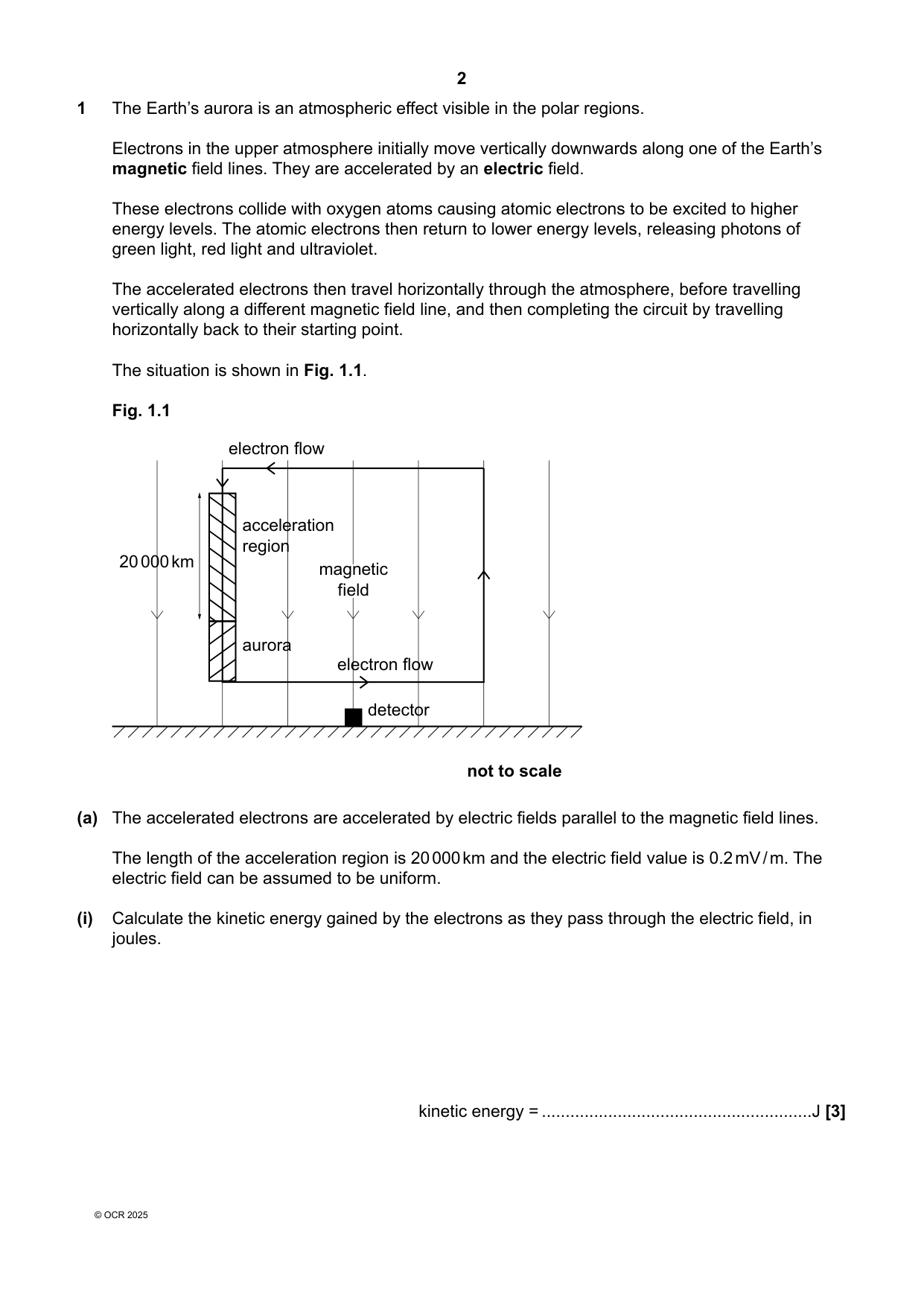
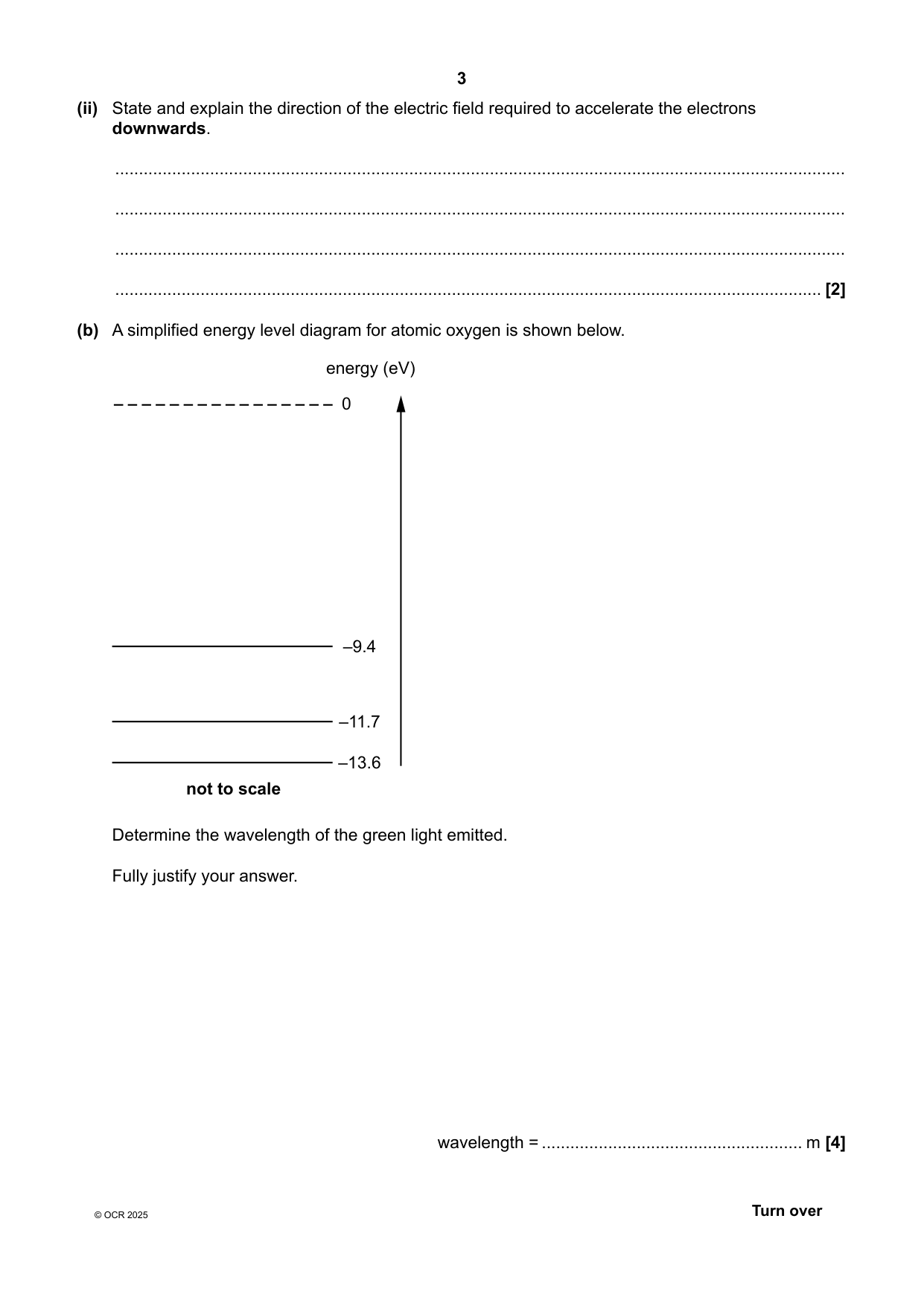
Question 1 investigates the Earth’s aurora and charged-particle motion in magnetic and electric fields. Students calculate the kinetic energy gained by electrons accelerated through Earth’s atmosphere, determine the direction of electric fields required for electron acceleration, calculate the wavelength of green light emitted from oxygen energy-level transitions, analyse magnetic-field directions produced by atmospheric currents, and evaluate the effects of high-altitude currents on the atmosphere.
Question 2 focuses on stationary waves and resonance using a wire driven by mains-frequency alternating current. Students explain the formation of stationary waves, derive and apply resonance equations involving tension and wire length, determine mass per unit length experimentally, analyse graph gradients and uncertainty using best-fit and worst-acceptable lines, and calculate the mains frequency with percentage uncertainty evaluation. The question also requires students to assess the accuracy of experimentally determined frequency values against the accepted UK mains frequency of 50.0 Hz.
Question 3 compares two large-scale energy-storage systems: gravitational potential energy storage using electrically powered trucks carrying sand up a mountain, and thermal-energy storage using heated wax. Students explain electromagnetic induction in regenerative systems, describe thermal energy storage in terms of particle behaviour, estimate energy storage per kilogram for both systems, evaluate overall efficiencies, and discuss which storage system is more suitable for storing surplus electrical energy.
Question 4 investigates the operation of an electroscope. Students explain why the centre of mass of the needle is below the pivot, interpret deflection-angle graphs, identify voltmeter zero error, estimate the number of stored electrons using capacitance relationships, and analyse electrostatic behaviour in charged systems.
Question 5 explores ionising radiation and insect sterilisation. Students explain how ionising radiation can cause infertility, compare the suitability of alpha radiation, gamma rays, and X-rays for sterilising large insect populations, describe how gamma rays and X-rays are produced, and evaluate the practical and safety considerations involved in laboratory sterilisation procedures.
Question 6 focuses on gravitational waves and black-hole collisions. Students define strain, calculate the force required to produce equivalent strain in copper wires using Young modulus, explain why gravitational-wave detection is extremely difficult, derive equations for orbital energy in binary black-hole systems, estimate orbital-energy loss from wave-period data, and calculate the power radiated during black-hole mergers using graphical analysis of gravitational-wave signals.
The paper includes several graph-analysis and derivation tasks involving strain-time graphs, resonance plots, uncertainty bars, and oscillation-period measurements. Students are required to apply AO1 Physics knowledge, AO2 application, and AO3 analytical reasoning to real-world engineering, medical, thermal, and astrophysical scenarios throughout the examination.
This OCR A Level Physics A Unified Physics question paper is ideal for timed exam practice, graph-analysis revision, uncertainty evaluation, advanced mathematical problem solving, practical-skills development, and improving AO1 knowledge, AO2 application, and AO3 analytical reasoning under authentic OCR examination conditions. Pair this paper with the official OCR H556/03 June 2025 mark scheme on markscheme.net for complete examiner-standard revision and self-assessment. Updated for the 2025/2026 academic year, fully mobile-friendly, and instantly downloadable.
This document is designed for A Level Physics students preparing for the 2026 OCR examination series, resit candidates improving Unified Physics exam performance, home-educated learners, and independent candidates studying OCR A Level Physics A. It is especially valuable for students practising derivations, uncertainty analysis, graph interpretation, resonance investigations, astrophysical calculations, and AO1/AO2/AO3 Physics exam technique under real OCR exam conditions.
Teachers, Physics departments, tutors, revision-course providers, intervention coordinators, and parents can use this official OCR question paper for mock examinations, graph-analysis workshops, retrieval practice, uncertainty-skills training, and benchmarking student responses against live June 2025 OCR assessment standards.
Download OCR A Level Physics A H556/02 June 2025 Question Paper Pdf For Exploring Phy...
Download OCR A Level Physics A H556/01 June 2025 Question Paper Pdf For Modelling Phy...
Download OCR A Level Physics A H556/03 June 2025 Mark Scheme Pdf For Unified Physics.
Download OCR A Level Physics A H556/02 June 2025 Mark Scheme Pdf For Exploring Physic...