



OCR / A Level
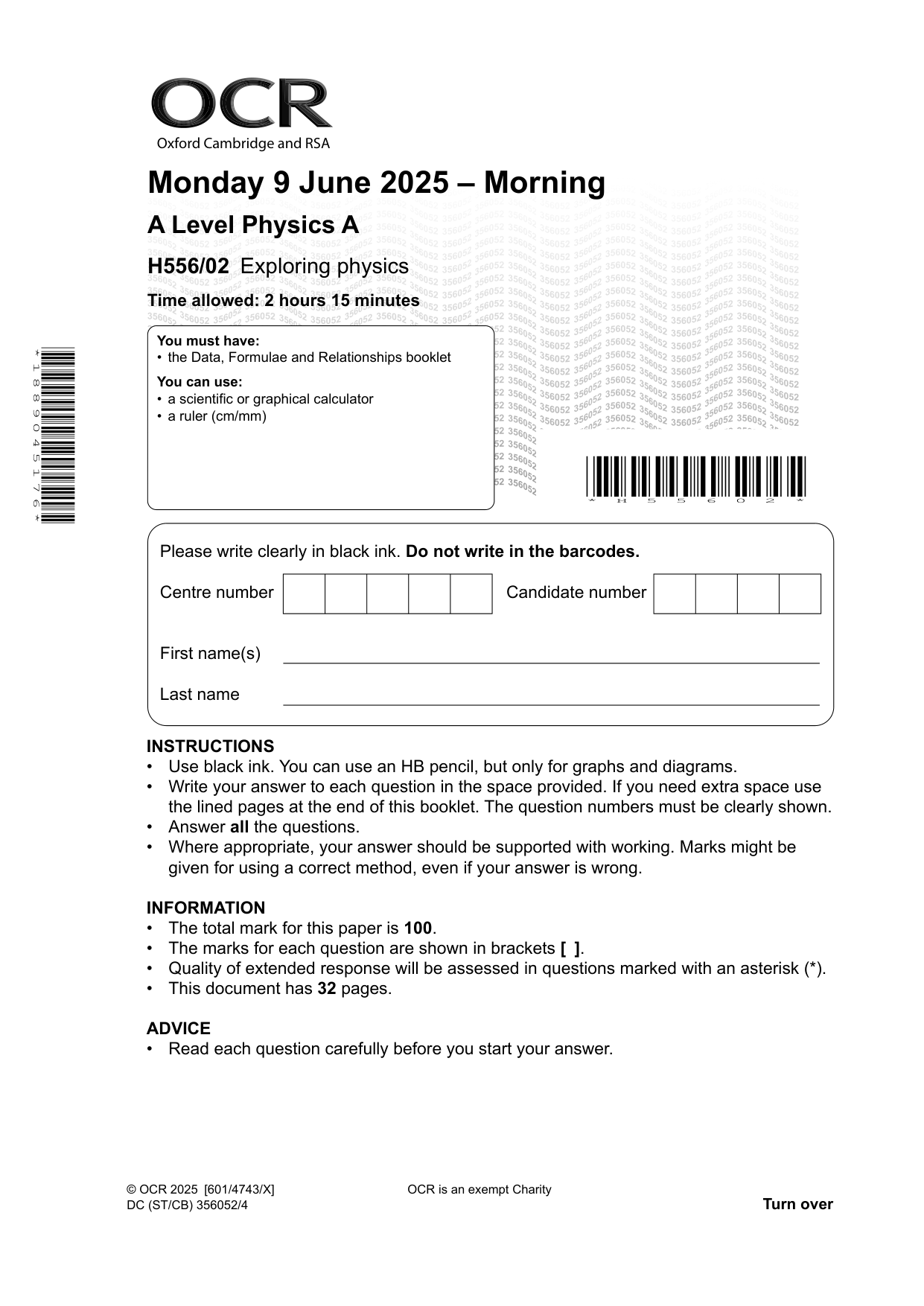
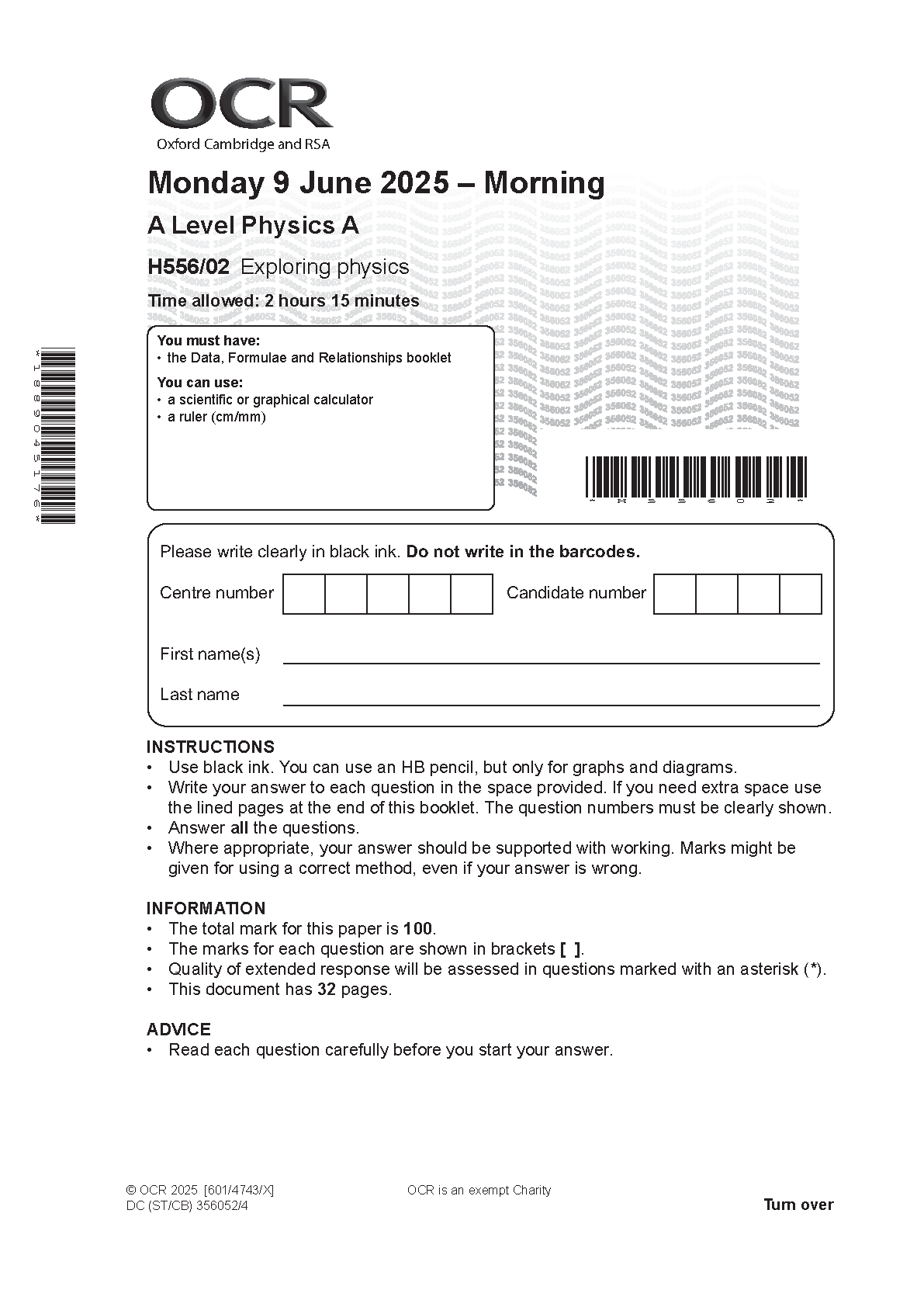
OCR A Level Physics A Paper 2 2025 Question Paper
Download the official OCR A Level Physics A H556/02 Exploring Physics question paper from the June 2025 examination series. This downloadable PDF contains the complete OCR A Level Physics A Paper 2 exam sat on Monday 9 June 2025, including multiple-choice questions, practical-investigation tasks, graph-analysis exercises, calculations, uncertainty evaluation, and extended-response Physics problems in the official OCR exam format.
The OCR H556/02 June 2025 question paper covers a broad range of advanced A Level Physics A topics including gamma cameras, nuclear binding energy, drift velocity, radioactive decay, electromotive force, stationary waves, uncertainty analysis, magnetic fields, attenuation of X-rays, particle physics, wave-particle duality, double-slit interference, polarisation, electromagnetic induction, capacitors, resistivity, semiconductors, PET scanning, and practical electrical investigations.
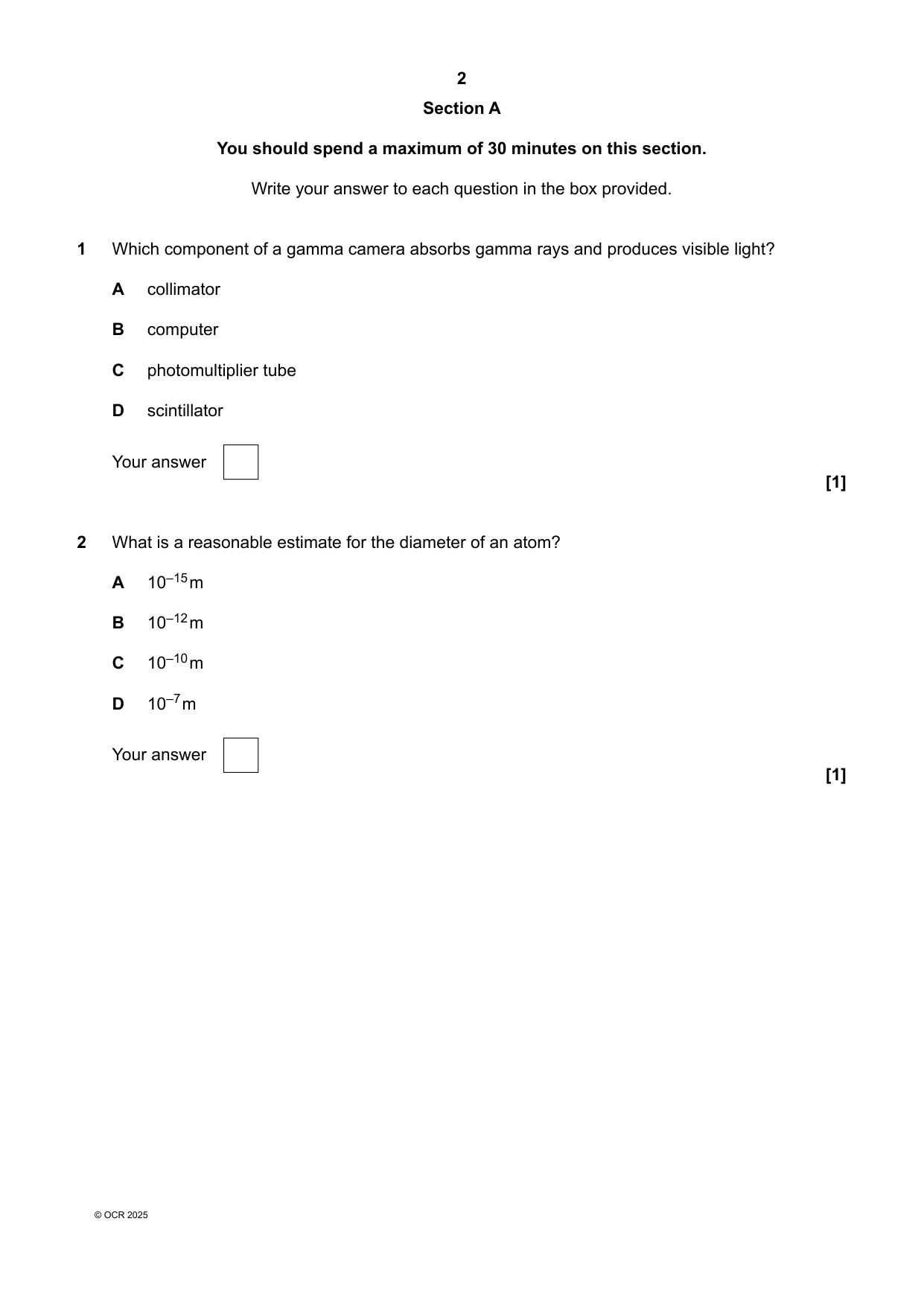
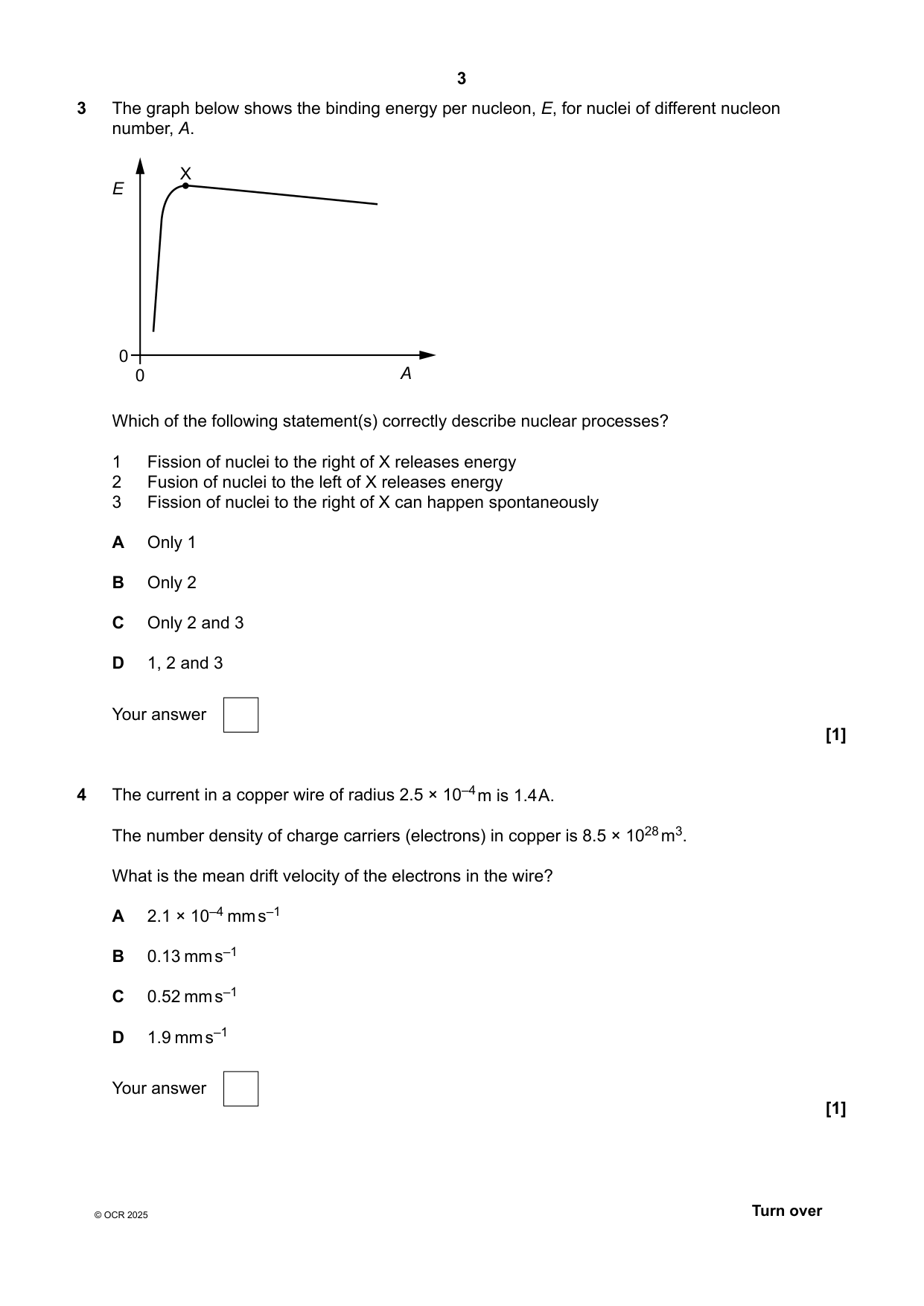
Section A contains multiple-choice questions testing conceptual understanding, mathematical Physics skills, graph interpretation, and advanced problem solving. Topics include gamma-camera components, atomic dimensions, nuclear fusion and fission, drift velocity in conductors, radioactive half-life, Geiger-counter measurements, terminal potential difference, stationary waves, percentage uncertainty, wave properties, magnetic-force calculations, solar radiation, vectors and scalars, particle charge quantisation, and ultrasound behaviour.
Question 16 investigates the behaviour of a light-emitting diode (LED) in a practical electrical circuit. Students analyse potential-divider arrangements, current direction, changes in ammeter and voltmeter readings, charge-carrier density in semiconductors, and the variation of electrical potential around a circuit loop involving a resistor, battery, and LED.
Question 17 is an extended-response task on wave-particle duality. Students describe the wave model of particles and the particle model of electromagnetic radiation, explain the experimental evidence supporting each model, and discuss how electrons and visible light demonstrate both wave-like and particle-like behaviour.
Question 18 focuses on X-ray production and medical imaging. Students identify the structure of an X-ray tube, explain why the anode rotates, describe electron interactions responsible for characteristic X-rays, calculate minimum X-ray wavelength from electron energy changes, and determine attenuation coefficients for tumour tissue using exponential attenuation equations.
Question 19 explores particle physics, radioactive decay, and PET scanning. Students compare hadrons and leptons, identify leptons in decay equations, calculate radioactive activity after decay over time, and explain how positron annihilation is used in medical imaging applications.
Question 20 investigates wave superposition, destructive interference, double-slit diffraction, fringe spacing, and plane polarisation. Students derive the approximate double-slit equation, analyse how changing wavelength affects fringe patterns, explain why white light produces coloured fringes, and discuss why sound waves cannot be plane polarised.
Question 21 examines electromagnetic induction and alternating-current generators. Students interpret CRO traces, analyse rotating-coil generators, calculate changes in flux linkage and induced e.m.f., determine current supplied from mains electricity, and identify the units used for electrical energy consumption in UK homes.
Question 22 focuses on capacitors and exponential discharge modelling. Students sketch charge-voltage graphs, explain how capacitor energy is determined graphically, calculate dielectric thickness using capacitance equations, evaluate experimental improvements, and analyse spreadsheet modelling of capacitor discharge using iterative calculations and exponential decay relationships.
Question 23 investigates the resistance of a constantan wire using a sliding-contact practical setup. Students derive resistance equations from circuit analysis, calculate resistance values, plot graphs of resistance against wire length, determine wire diameter from graph gradients and resistivity equations, and explain how the sliding-contact arrangement improves measurement quality and precision.
This OCR A Level Physics A Exploring Physics question paper is ideal for timed exam practice, graph-analysis revision, practical-skills development, uncertainty evaluation, modern-physics revision, and improving AO1 knowledge, AO2 application, and AO3 analytical reasoning under authentic OCR examination conditions. Pair this paper with the official OCR H556/02 June 2025 mark scheme on markscheme.net for complete examiner-standard revision and self-assessment. Updated for the 2025/2026 academic year, fully mobile-friendly, and instantly downloadable.
This document is designed for A Level Physics students preparing for the 2026 OCR examination series, resit candidates improving Exploring Physics exam performance, home-educated learners, and independent candidates studying OCR A Level Physics A. It is especially valuable for students practising uncertainty calculations, graph interpretation, practical investigations, wave behaviour, particle physics, electrical circuits, and AO1/AO2/AO3 Physics exam technique under real OCR exam conditions.
Teachers, Physics departments, tutors, revision-course providers, intervention coordinators, and parents can use this official OCR question paper for mock examinations, classroom discussion, graph-analysis workshops, practical-skills training, and benchmarking student responses against live June 2025 OCR assessment standards.
Download OCR A Level Physics A H556/03 June 2025 Question Paper Pdf For Unified Physi...
Download OCR A Level Physics A H556/01 June 2025 Question Paper Pdf For Modelling Phy...
Download OCR A Level Physics A H556/03 June 2025 Mark Scheme Pdf For Unified Physics.
Download OCR A Level Physics A H556/02 June 2025 Mark Scheme Pdf For Exploring Physic...