



OCR / A Level
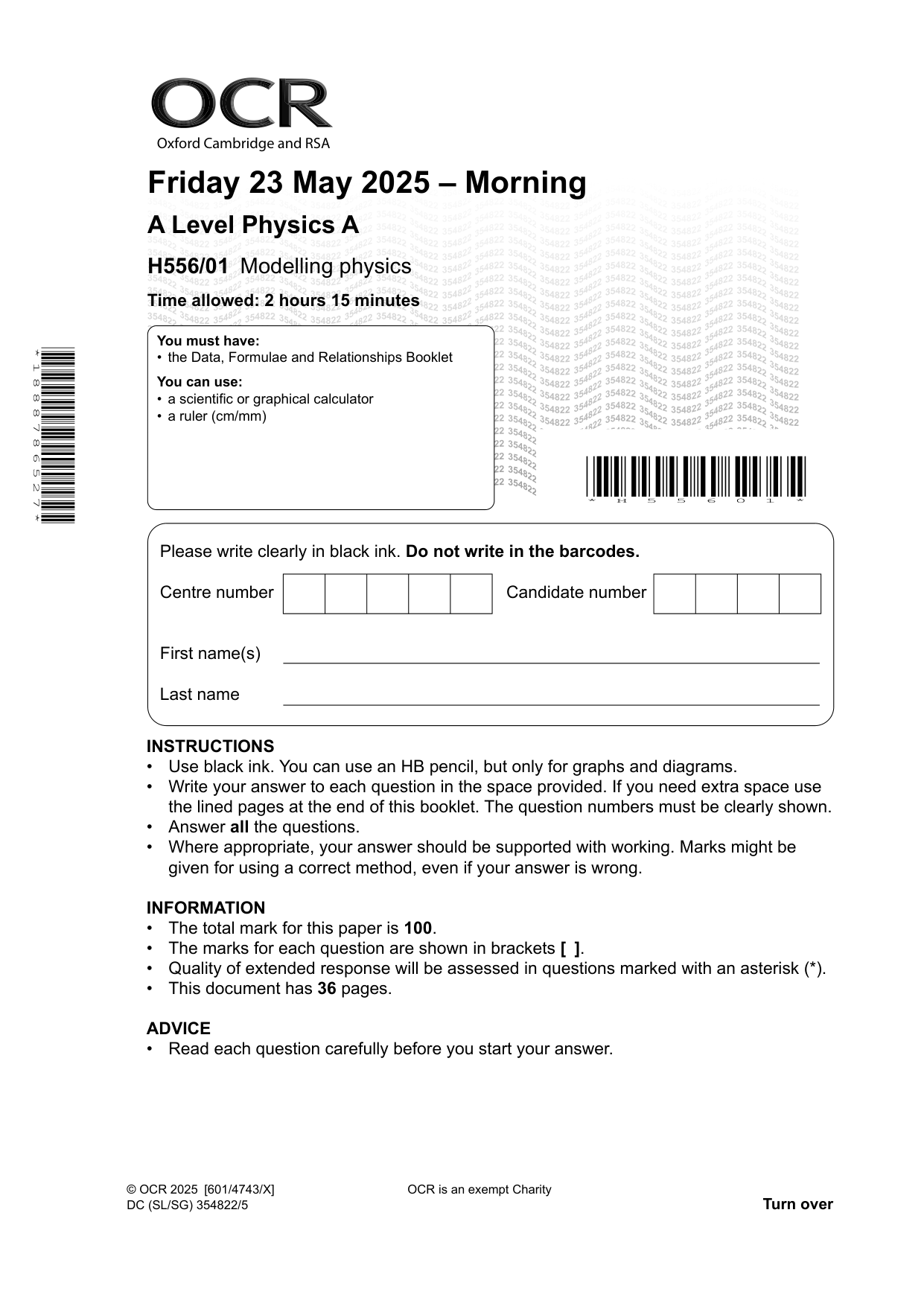
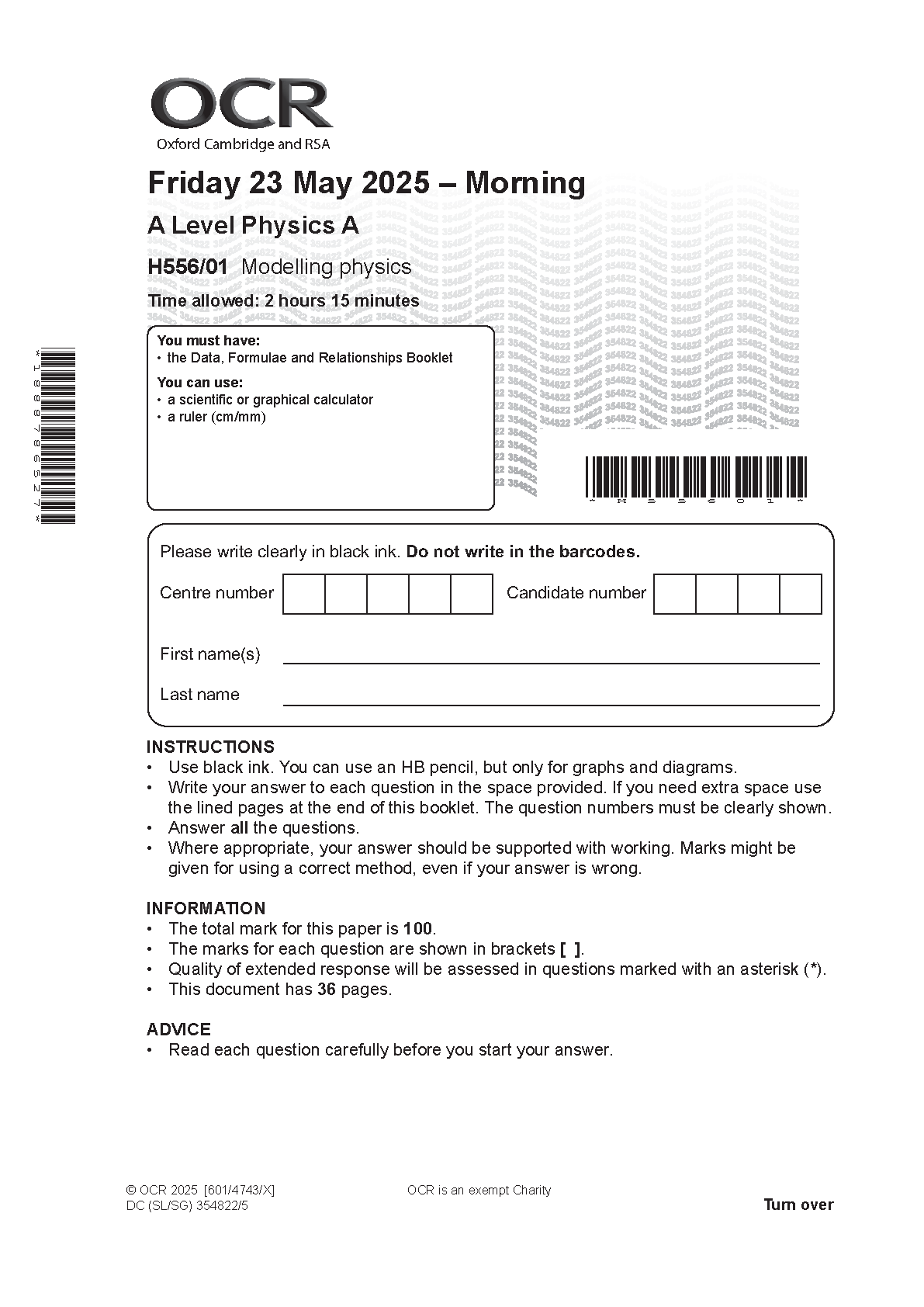
OCR A Level Physics A Paper 1 2025 Question Paper
Download the official OCR A Level Physics A H556/01 Modelling Physics question paper from the June 2025 examination series. This downloadable PDF contains the complete OCR A Level Physics A Paper 1 exam sat on Friday 23 May 2025, including multiple-choice questions, graph-analysis tasks, practical-investigation problems, calculations, uncertainty evaluation, and extended-response Physics questions in the official OCR exam format.
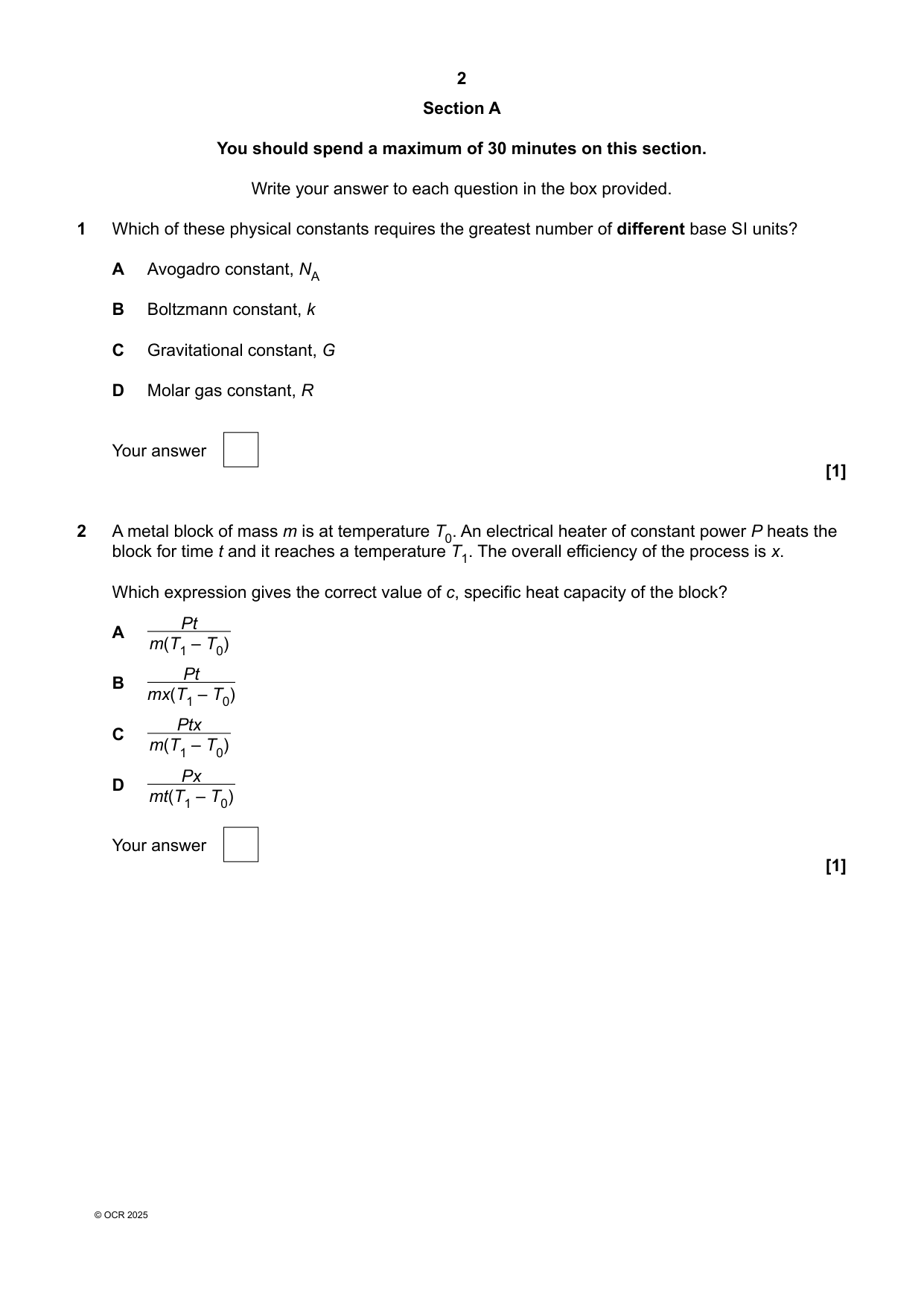
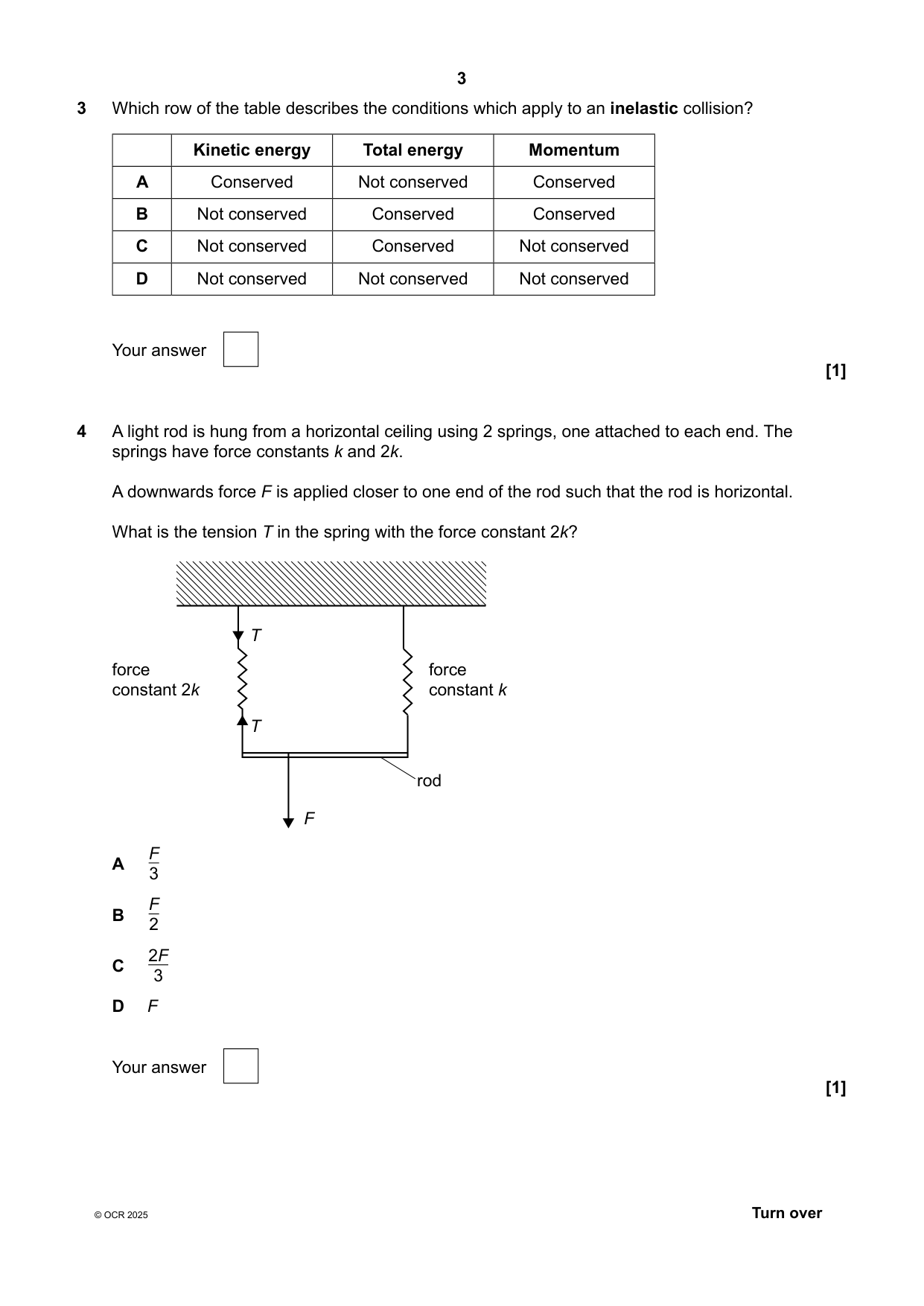
The OCR H556/01 June 2025 question paper covers a broad range of advanced A Level Physics A topics including specific heat capacity, inelastic collisions, moments and equilibrium, simple harmonic motion, projectile motion, diffraction gratings, circular motion, gravitation, stellar evolution, cosmology, momentum, oscillations, thermal physics, latent heat, ideal gases, Kepler’s laws, Hubble’s law, absorption spectra, and astrophysics calculations.
Section A contains multiple-choice questions testing conceptual understanding, mathematical Physics skills, graph interpretation, and advanced problem solving. Topics include SI base units, heating efficiency, collisions, spring systems, state changes, momentum transfer between walls, stellar parallax, centripetal force, gravitational attraction, stellar evolution, diffraction gratings, Wien’s displacement law, SHM behaviour, and cosmological principles.
Question 16 investigates the motion of an electric car under constant motor force. Students analyse velocity-time and force-time graphs, estimate distance travelled from graphical methods, determine acceleration and change in momentum, explain resistive-force behaviour, apply Newton’s third law to frictional thrust, and calculate resultant force and driving force during acceleration.
Question 17 explores projectile motion using an aircraft experiencing apparent weightlessness. Students calculate time of flight, determine resultant velocity and angle, explain why thrust is still required during projectile motion, analyse gravitational field strength at altitude, and explain why passengers appear weightless despite Earth’s gravity still acting.
Question 18 focuses on a floating cylindrical wave-energy generator. Students apply Archimedes’ principle, calculate displacement depth, explain equilibrium conditions, derive restoring-force equations, demonstrate simple harmonic motion, determine natural frequency, and evaluate machine designs using resonance behaviour and ripple-tank investigations.
Question 19 investigates thermal energy transfer and evaporation in a liquid-oxygen storage tank. Students explain latent heat and particle-energy changes, calculate evaporation rates, determine volume changes, and apply ideal-gas equations to calculate gas pressure inside the tank.
Question 20 analyses the relationship between specific heat capacity and particle number density in noble gases. Students complete missing data, plot graphs, determine trends, and explain the relationship between particle count and thermal-energy storage.
Question 21 is an extended-response astrophysics task comparing the absorption spectra of Vega and Tau Ceti. Students explain the formation of dark absorption lines, analyse spectral differences, evaluate stellar composition and temperature, and determine which star is older using evidence from stellar spectra.
Question 22 explores orbital mechanics using an asteroid orbiting the Sun. Students apply Kepler’s third law, calculate orbital period and kinetic energy, analyse changes in gravitational potential energy, and explain features of elliptical orbits according to Kepler’s first law.
Question 23 focuses on redshift and cosmology using the galaxy M87. Students calculate recession velocity from hydrogen-alpha spectral lines, estimate galactic distance using Hubble’s law, determine uncertainty from emission-line width, evaluate deviations from Hubble’s law, and explain why the Big Bang model remains scientifically accepted.
This OCR A Level Physics A Modelling Physics question paper is ideal for timed exam practice, graph-analysis revision, uncertainty evaluation, mathematical problem solving, astrophysics revision, and improving AO1 knowledge, AO2 application, and AO3 analytical reasoning under authentic OCR examination conditions. Pair this paper with the official OCR H556/01 June 2025 mark scheme on markscheme.net for complete examiner-standard revision and self-assessment. Updated for the 2025/2026 academic year, fully mobile-friendly, and instantly downloadable.
This document is designed for A Level Physics students preparing for the 2026 OCR examination series, resit candidates improving Modelling Physics exam performance, home-educated learners, and independent candidates studying OCR A Level Physics A. It is especially valuable for students practising advanced calculations, graph interpretation, uncertainty analysis, oscillations, astrophysics, and AO1/AO2/AO3 Physics exam technique under real OCR exam conditions.
Teachers, Physics departments, tutors, revision-course providers, intervention coordinators, and parents can use this official OCR question paper for mock examinations, graph-analysis workshops, retrieval practice, uncertainty-skills training, and benchmarking student responses against live June 2025 OCR assessment standards.
Download OCR A Level Physics A H556/03 June 2025 Question Paper Pdf For Unified Physi...
Download OCR A Level Physics A H556/02 June 2025 Question Paper Pdf For Exploring Phy...
Download OCR A Level Physics A H556/03 June 2025 Mark Scheme Pdf For Unified Physics.
Download OCR A Level Physics A H556/02 June 2025 Mark Scheme Pdf For Exploring Physic...