



AQA / AS Level
AQA As Chemistry Paper 2 2025 Question Paper Pdf
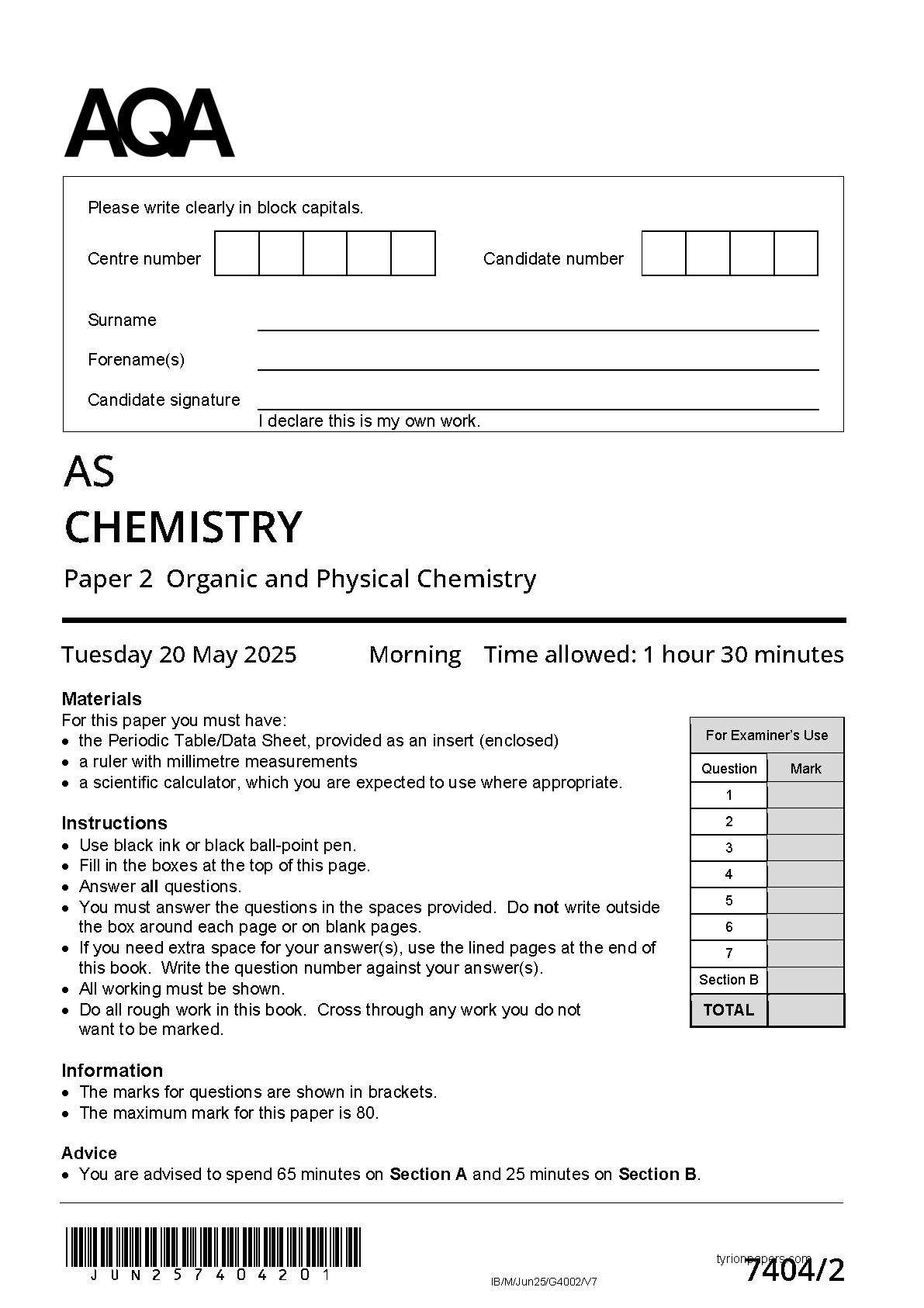
Download the official AQA AS Chemistry Paper 2 question paper from the May 2025 series (7404/2), sat on **Tuesday 20 May 2025 (morning)**. This paper focuses on **Organic and Physical Chemistry** and is worth **80 marks over 1 hour 30 minutes**.
The paper combines organic mechanisms, spectroscopy, equilibrium, energetics, and practical-based calculations:
**Section A (structured questions):**
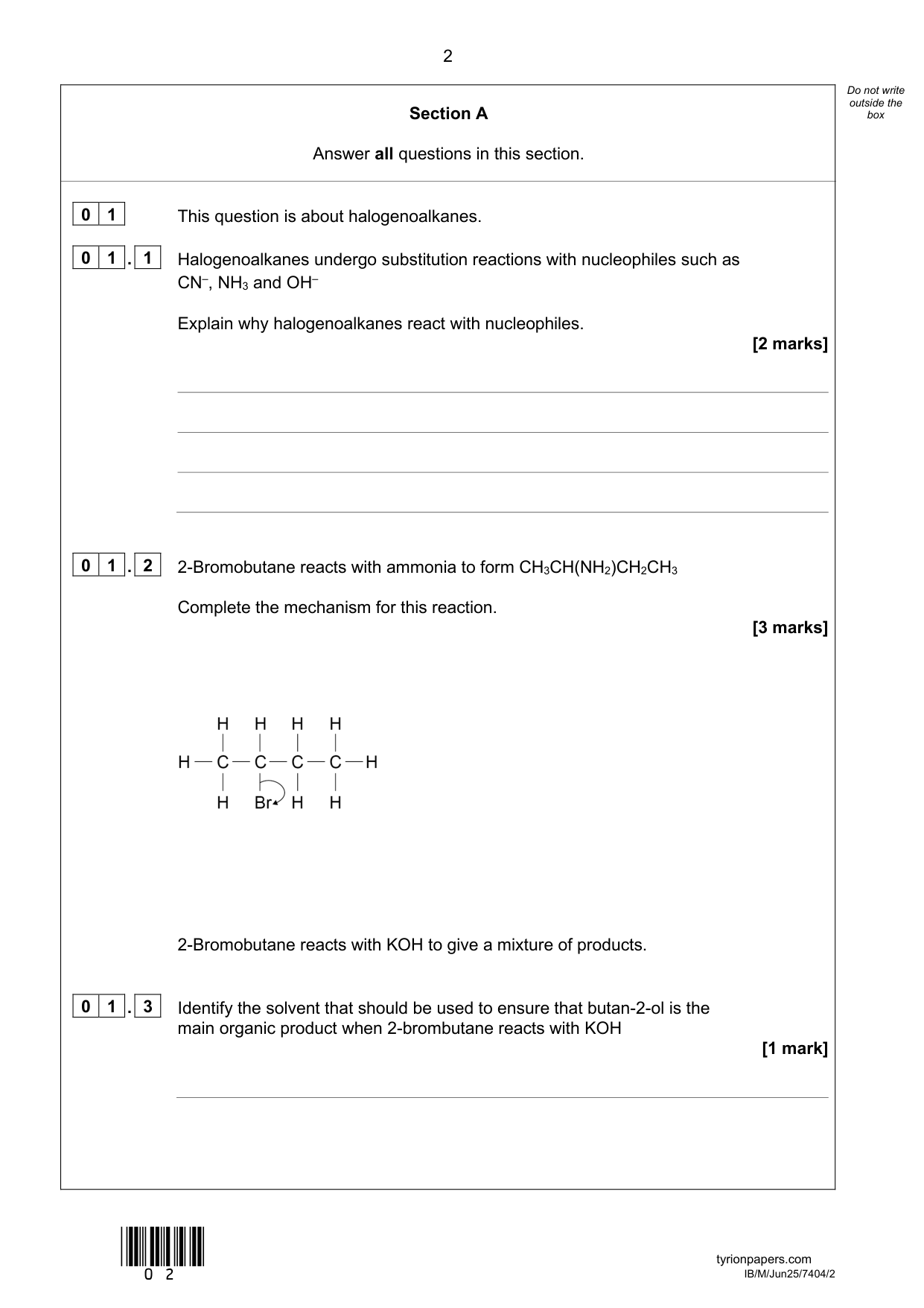
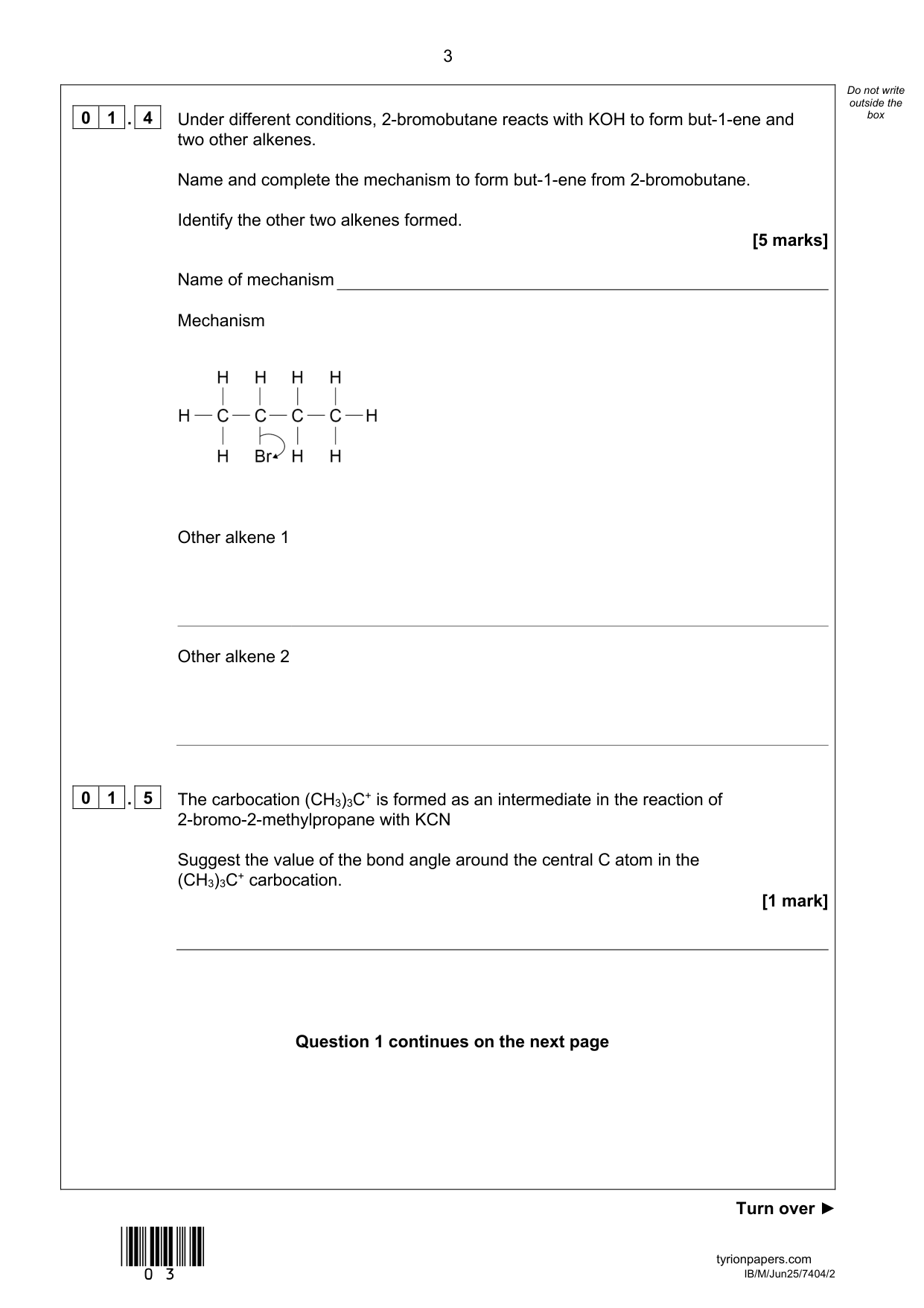
- **Question 1 (pages 2–4):** Halogenoalkanes:
- Nucleophilic substitution explanations
- Mechanisms (reaction with NH₃ and KOH)
- Elimination to form alkenes (E1/E2)
- Carbocation structure and bond angle (~120°)
- Co-ordinate bond formation with CN⁻
- **Question 2 (page 5):** Methanol production:
- Catalysts and activation energy
- Temperature effects on rate
- Hydrogen bonding (diagram required with lone pairs and δ⁺/δ⁻)
- **Question 3 (page 6):** Intermolecular forces:
- Comparison of **CCl₄ vs CHCl₃ boiling points**
- Explanation of tetrahedral shape and polarity
- London forces vs permanent dipole interactions
- **Question 4 (pages 8–9):** Organic analysis:
- Functional group isomerism (C₄H₆O₂)
- Bromine water test for alkenes
- IR spectroscopy interpretation (ranges 3230–3550 cm⁻¹ and 1620–1680 cm⁻¹)
- Polymerisation of vinyl acetate
- **Question 5 (pages 11–13):** Mass spectrometry & gas calculations:
- High-resolution MS explanation
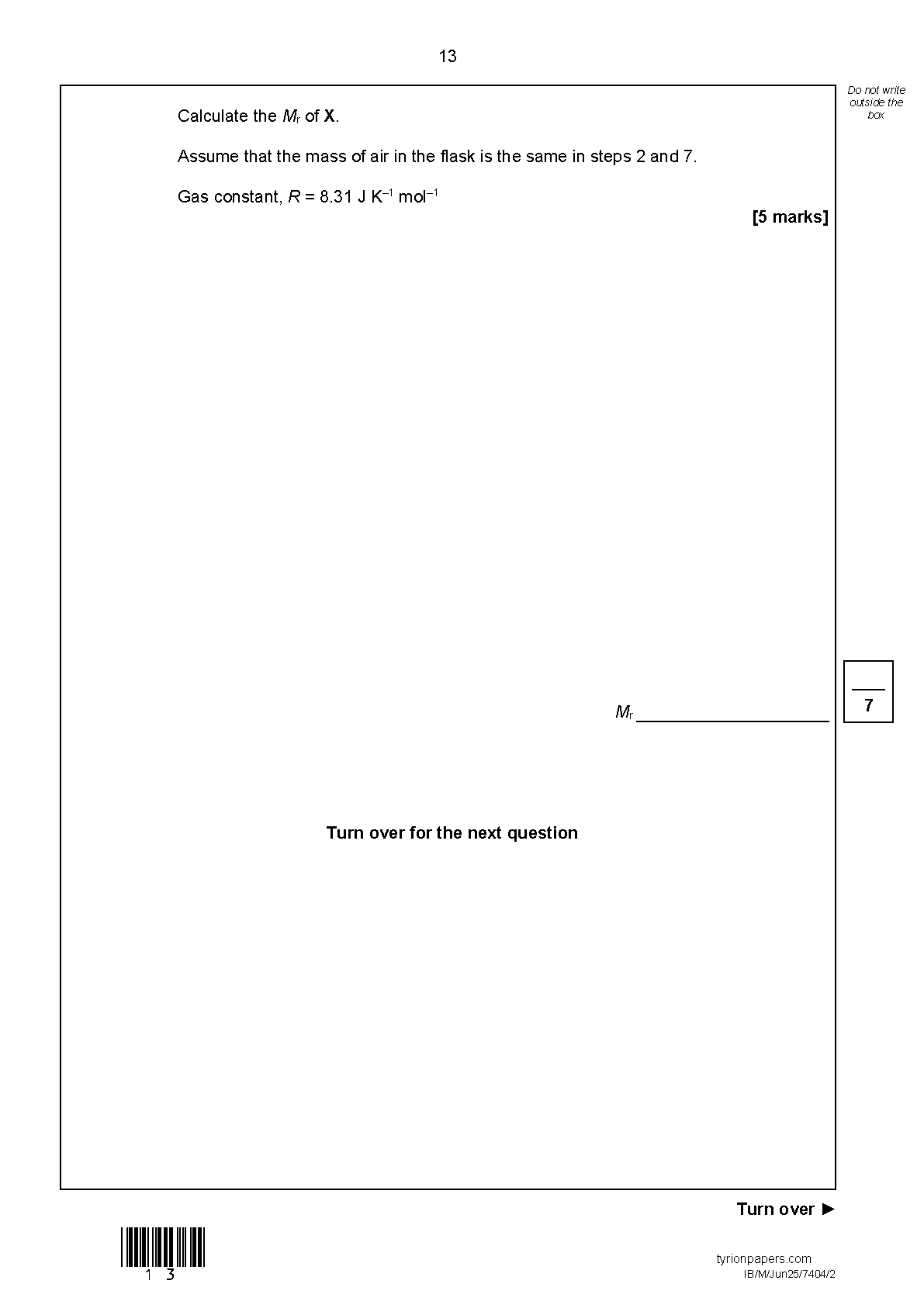
- Determination of Mr using the ideal gas equation
- Practical setup using a conical flask (Figure 1, page 12)
- **Question 6 (pages 15–18):** Organic synthesis & practical chemistry:
- Hydration of cyclohexene (mechanism required)
- Distillation setup (Figure 2, page 16)
- Role of condenser (water in at bottom)
- Anti-bumping granules and safety considerations
- Dehydration mechanism (elimination)
- Combustion of cyclohexanol and carbon-neutral discussion
- **Question 7 (pages 19–20):** Energetics:
- Definition of enthalpy change
- Calorimetry calculation using q = mcΔT
- Bond enthalpy expressions
- Determination of alkane formula from ΔHc
For example, **Table 2 on page 20** provides bond enthalpies (C=O and O–H), which are used to derive expressions like *2536n + 926* for products.
**Section B (multiple choice, pages 21–27):**
Includes 15 questions testing:
- Organic naming and stereochemistry
- Cracking and combustion
- Oxidation of alcohols
- Atmospheric chemistry (CFCs and ozone)
- Fractional distillation trends
- Greenhouse gases
- Enthalpy of formation calculations
- Maxwell–Boltzmann distributions
- Reaction rates and conditions
Examples:
- Naming aldehydes (page 21)
- Catalytic cracking produces alkenes (page 22)
- SO₂ contains polar bonds (page 23)
- Ozone depletion via Cl radicals (page 24)
- IR-absorbing greenhouse gases (page 24)
This paper is essential for mastering organic mechanisms, spectroscopy, calculations, and synoptic AS Chemistry skills required for top grades.
Fully updated for the 2025/2026 academic year and optimised for instant download on markscheme.net.
This paper is ideal for Year 12 students preparing for AQA AS Chemistry exams and Year 13 students reinforcing organic and physical chemistry fundamentals.
Teachers and tutors use this resource for mock exams, timed practice, and teaching key mechanisms and calculations. It is also perfect for independent learners aiming to improve exam technique.
Download AQA As Chemistry Paper 2 (7404/2) June 2025 Mark Scheme Pdf With Full Answer...
Download AQA As Chemistry Paper 1 (7404/1) June 2025 Mark Scheme Pdf With Full Worked...

Download AQA As Chemistry Paper 1 (7404/1) May 2025 Question Paper Pdf. Free Instant...