



AQA / A Level
AQA A Level Chemistry Paper 3 2025 Mark Scheme Pdf
Download the official AQA A-Level Chemistry Paper 3 mark scheme for the June 2025 exam (7405/3). This is the final examiner-approved marking guide used during standardisation, containing full worked answers, mark allocations, and detailed examiner guidance.
The mark scheme provides complete solutions across all sections of the synoptic paper:
**Section A (structured & practical questions):**
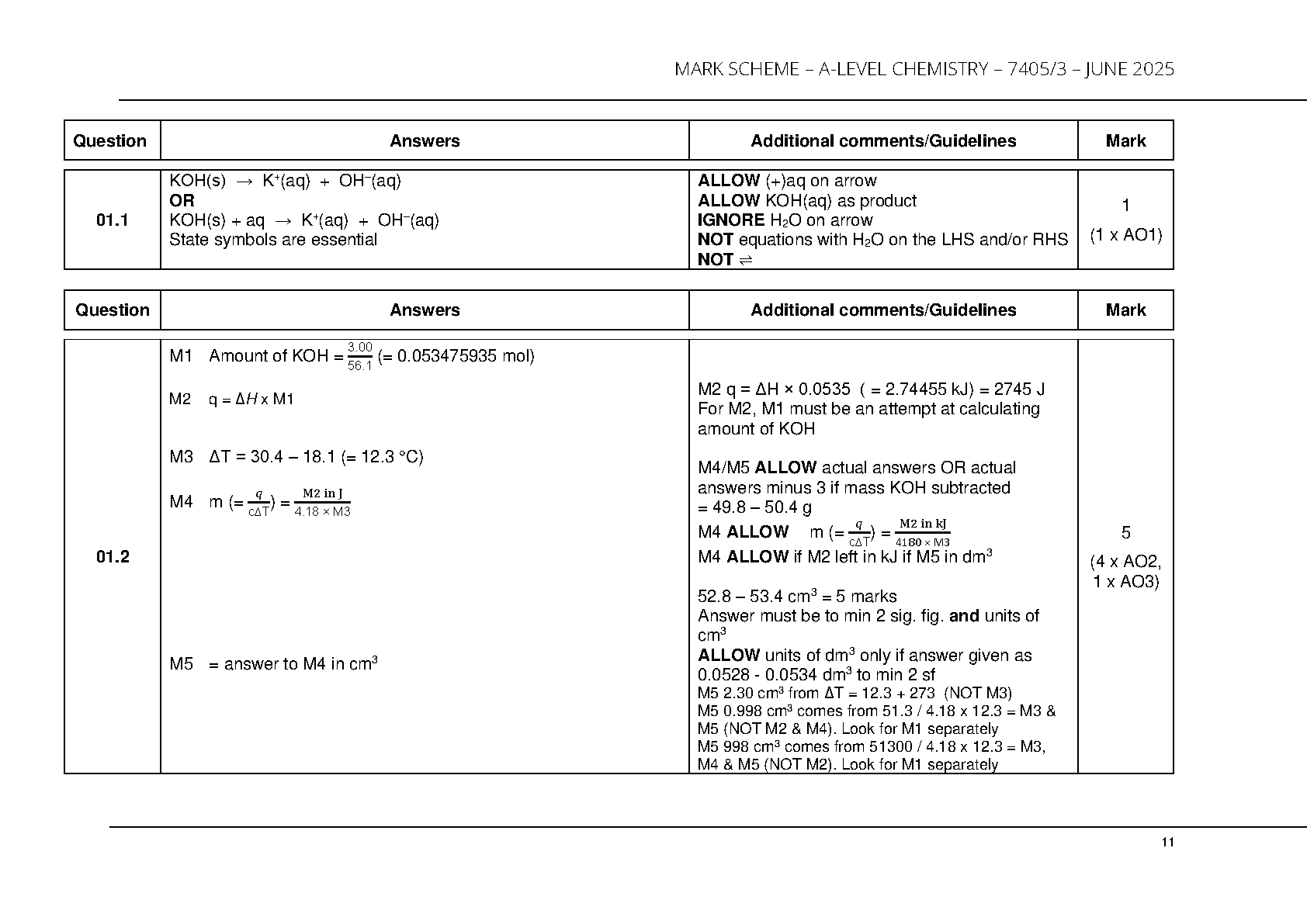
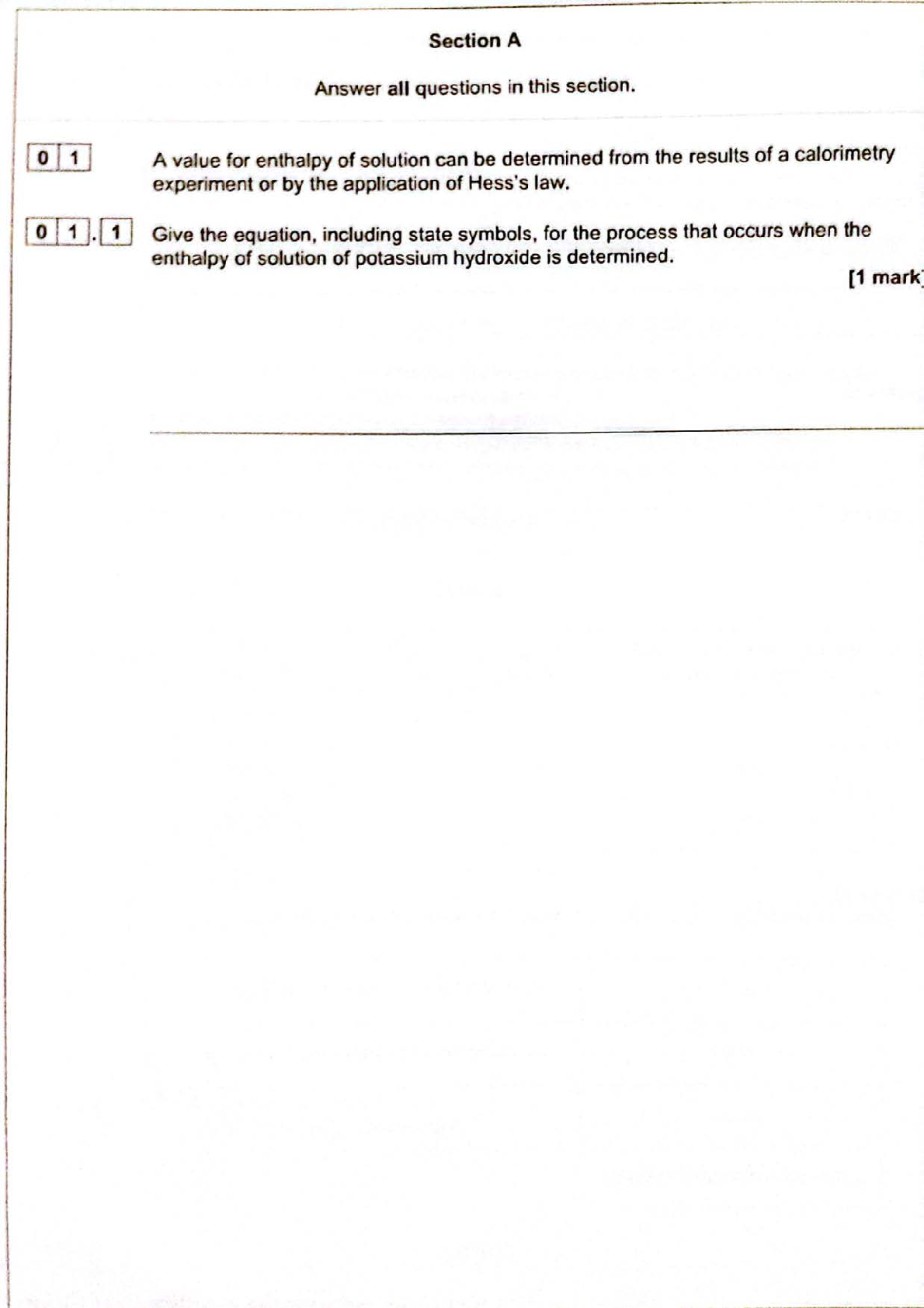
- **Question 1 (pages 11–12):** Full calorimetry solution including correct equation *KOH(s) → K⁺(aq) + OH⁻(aq)* and calculation of water volume (~52.8–53.4 cm³). Also includes Hess’s Law calculation giving **ΔH solution = –61 kJ mol⁻¹** and explanation of experimental error (heat loss).
- **Question 2 (pages 13–15):** Kinetics analysis showing rate law **rate = k[H₂O₂][I⁻]**, orders of reaction (first order in H₂O₂ and I⁻, zero in H⁺), and calculated rate **≈ 6.25 × 10⁻⁷ mol dm⁻³ s⁻¹**. Includes uncertainty analysis (2.5%) and evaluation of experimental limitations.
- **Question 3 (pages 16–17):** Electrochemistry answers including corrections to electrode setup, identification of high resistance voltmeter, and full redox equation **2Fe³⁺ + H₂ → 2Fe²⁺ + 2H⁺**. EMF calculation gives **+0.78 V** with correct cell notation.
- **Question 4 (pages 18–19):** Equilibrium calculations with full Kc expression and final value **Kc ≈ 45.9 mol⁻¹ dm³**, including step-by-step mole and concentration calculations.
**Section B (extended response & organic chemistry):**
- **Question 5 (pages 20–22):** Level-of-response marking for oxidation of alcohols. Includes use of **acidified potassium dichromate(VI)**, correct equations for forming aldehydes/ketones, chemical tests (Tollens’/Fehling’s), and IR spectroscopy (O–H stretch 3230–3550 cm⁻¹ and fingerprint region).
- Practical setup answers include reflux apparatus (vertical condenser, water in/out) and use of anti-bumping granules to ensure smooth boiling.
**Organic & applied chemistry (pages 22–23):**
- Stereochemistry: **E/Z isomerism** identified correctly
- Ester chemistry: identification of double bond position and number of stereoisomers
- Hydrolysis products: soap formation (e.g. C₁₇H₃₁COO⁻Na⁺) and use as surfactants
**Multiple-choice answers (pages 23–25):**
The mark scheme provides all correct answers for questions 7–36. For example:
- Q7: B (quaternary ammonium ion structure)
- Q12: A (19 electrons)
- Q25: B (radon in p-block)
- Q28: A (thermal cracking produces alkenes)
- Q31: C (tetrahedral/pyramidal shape identification)
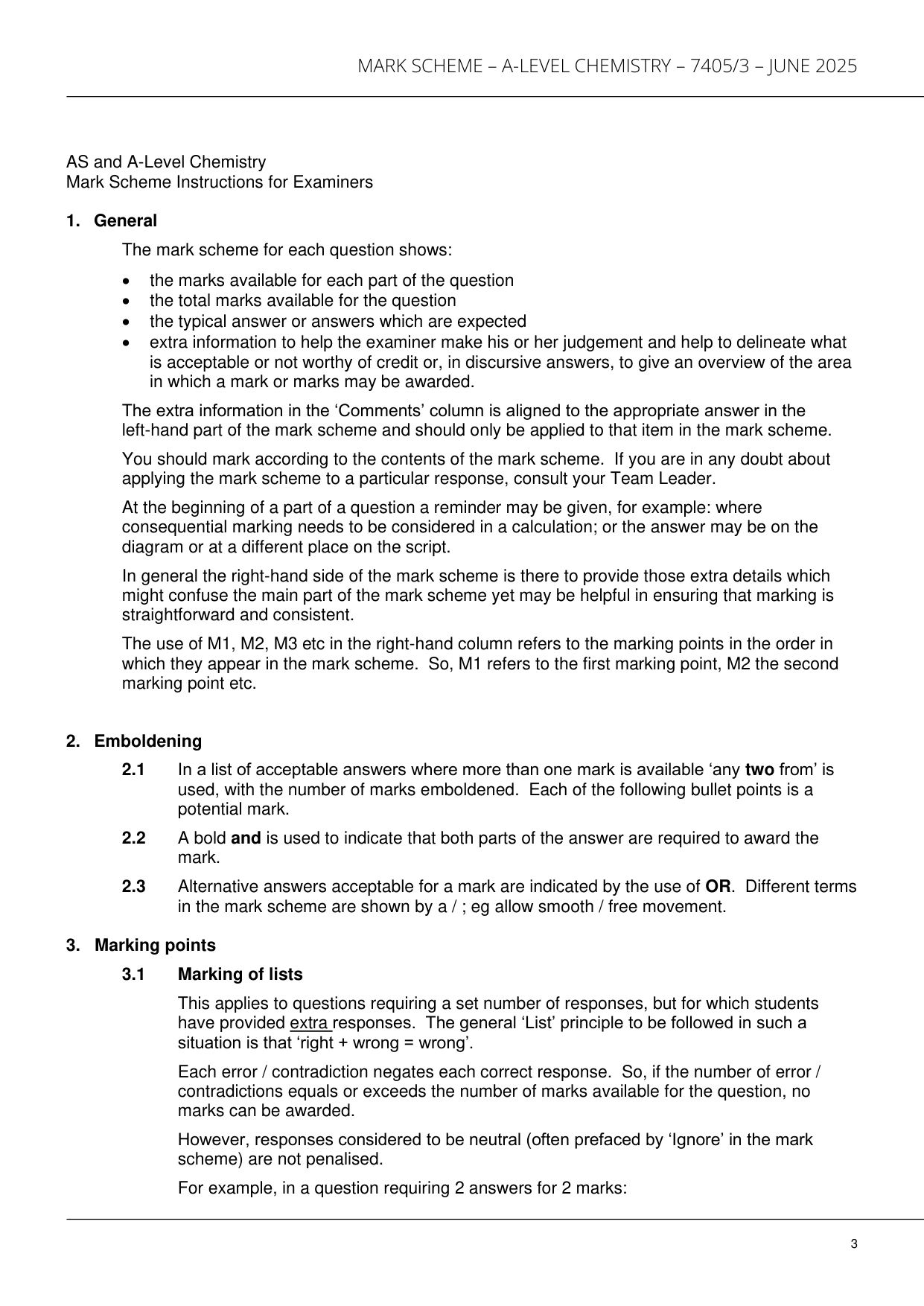
Additionally, the mark scheme explains key examiner principles such as:
- **Error carried forward (ECF)** in calculations
- **Best-fit marking** for extended responses
- Rules for organic structures, mechanisms, and nomenclature
- How marks are awarded for working vs final answers
This resource is essential for understanding exactly how marks are awarded, mastering calculations, and improving extended answers for top A/A* performance. Fully updated for the 2025/2026 academic year and optimised for instant download on markscheme.net.
This mark scheme is essential for Year 13 students preparing for the 2026 AQA A-Level Chemistry exams who want to master Paper 3, particularly synoptic and practical-based questions.
Teachers and tutors use this resource to standardise marking, provide precise feedback, and model top-level responses. It is also ideal for independent learners and retake students who want full worked solutions and insight into examiner expectations.
Download AQA A Level Chemistry Paper 3 (7405/3) June 2025 Question Paper Pdf. Free In...
Download AQA A Level Chemistry Paper 2 (7405/2) June 2025 Mark Scheme Pdf With Full A...
Download AQA A Level Chemistry Paper 2 (7405/2) June 2025 Question Paper Pdf. Free In...
Download AQA A Level Chemistry Paper 1 (7405/1) June 2025 Question Paper Pdf. Free In...