



AQA / A Level
AQA A Level Business Paper 2 2025 Mark Scheme Pdf
Download the official AQA A-Level Business Paper 2 mark scheme for the June 2025 exam (7132/2). This is the final examiner-approved marking guide used during standardisation, containing full answers, detailed mark allocations, and level-of-response criteria for extended questions.
The mark scheme provides complete solutions for all calculation and data-response questions. For example, Question 1.1 confirms the correct closing balance for November as **£1.08 million**, based on revised cash flow assumptions with zero inflows and £3.22m outflows (page 5). Question 2.1 provides the labour turnover calculation, showing **16%** using 960 leavers out of an average workforce of 6000 (page 10).
Analytical questions include structured indicative content and level descriptors. For instance, Question 1.3 explains why SCF chose to build a new factory in Spain, highlighting a higher expected net gain (£3.6m vs £2.1m for upgrading the UK site) and alignment with EU market growth (page 7). Question 1.2 explains falling inventory turnover (from 5.9 to 5.2 times), suggesting causes such as reduced efficiency or increased stockholding (page 6).
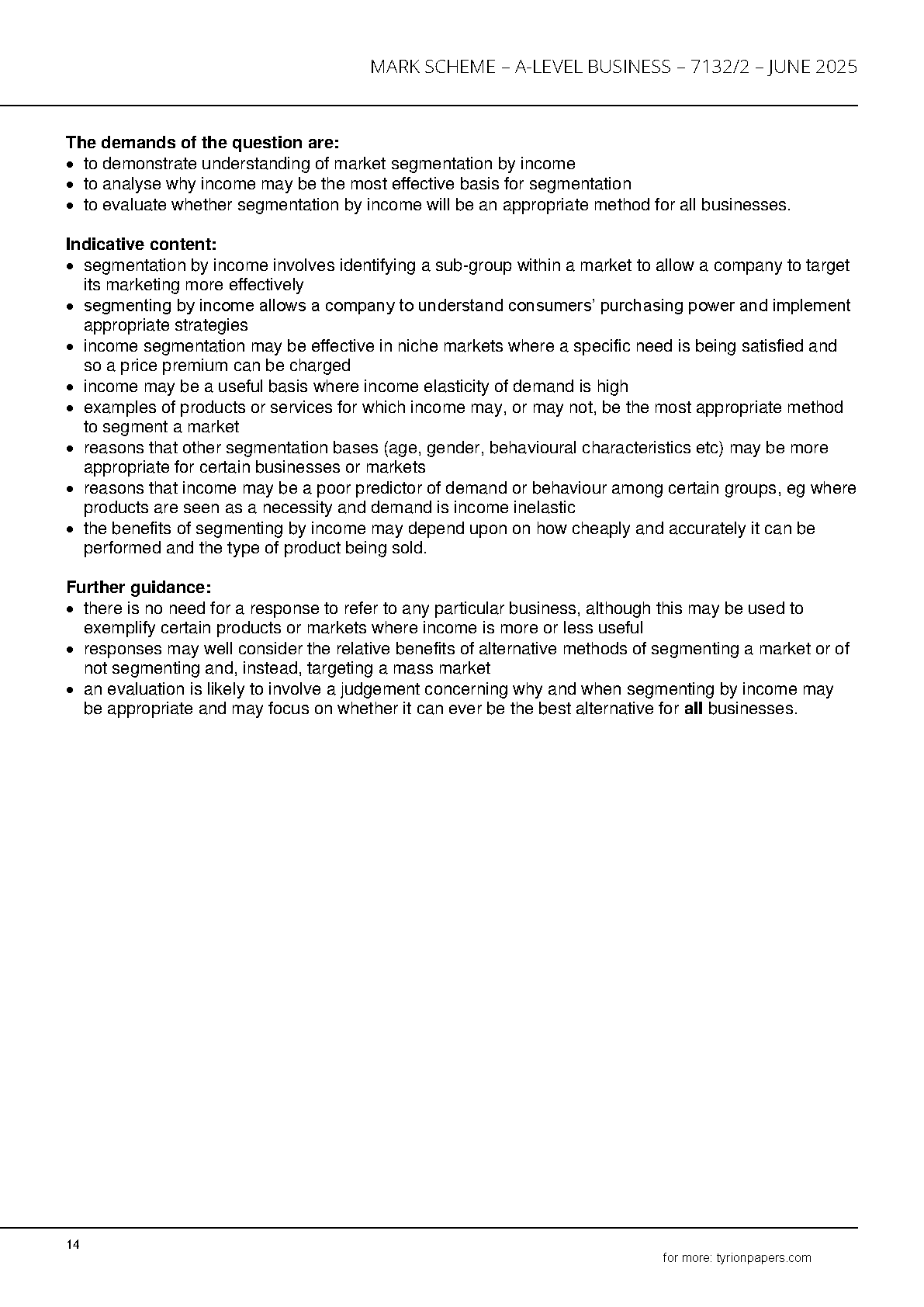
Extended-response questions are marked using AQA’s level-of-response system (Levels 1–4 or 1–5 depending on marks). For example, Question 1.4 (16 marks) requires balanced evaluation of economic threats and opportunities such as rising UK unemployment, increasing interest rates, EU growth, and exchange rate changes (pages 8–9). Similarly, Question 2.4 evaluates market segmentation by income, requiring judgement on when it is appropriate versus other segmentation methods (pages 13–14).
The mark scheme also provides detailed application of business theories. For example, Herzberg’s motivation theory is used in Question 2.3 to explain why training and development may not improve motivation if hygiene factors such as pay and working conditions are poor (page 12). In Question 3.3, cost leadership is analysed through efficient use of non-current assets alongside alternative strategies such as economies of scale and innovation (pages 18–19).
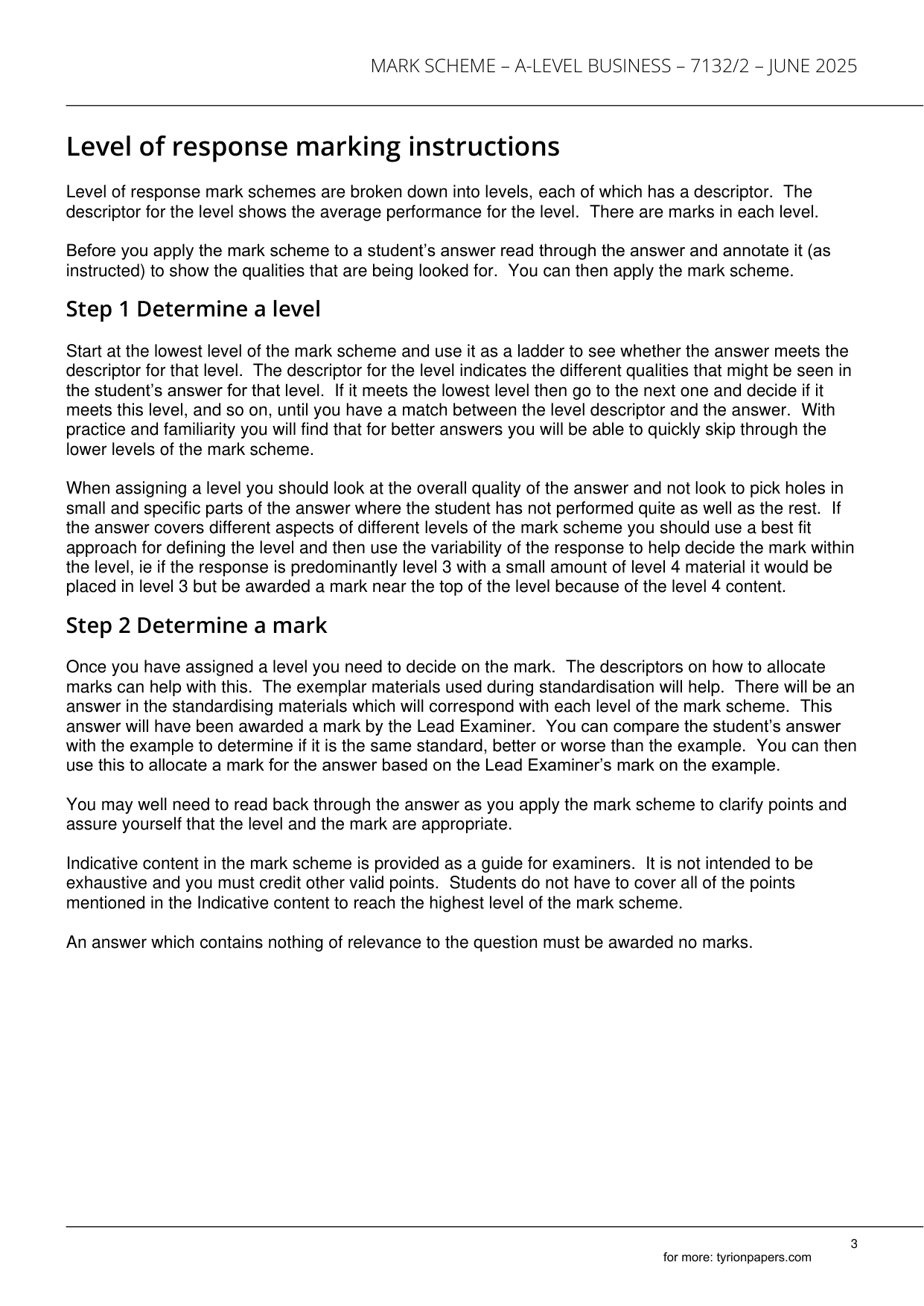
Additionally, the document explains key examiner principles such as the “best fit” approach, use of indicative content, and marking annotations including evaluation (J/EVAL), developed argument (DEV), and context (CON) (pages 3–4). This provides valuable insight into how high-level Business answers are assessed.
This resource is essential for understanding how to gain full marks, structure analytical and evaluative responses, and avoid common mistakes in A-Level Business exams. Fully updated for the 2025/2026 academic year and optimised for instant download on markscheme.net.
This mark scheme is essential for Year 13 students preparing for the 2026 AQA A-Level Business exams who want to master Paper 2, particularly data-response and case-study questions.
Teachers and tutors use this resource to standardise marking, provide precise feedback, and model high-quality answers. It is also ideal for independent learners and retake students who want detailed worked solutions and insight into examiner expectations.
Download AQA A Level Business Paper 3 (7132/3) June 2025 Mark Scheme Pdf With Full Of...
Download AQA A Level Business Paper 3 (7132/3) June 2025 Question Paper Pdf. Free Ins...
Download AQA A Level Business Paper 2 (7132/2) May 2025 Question Paper Pdf. Free Inst...
Download AQA A Level Business Paper 1 (7132/1) June 2025 Mark Scheme Pdf With Full Of...