



AQA GCSE Trilogy Chemistry 1H 2025 Mark Scheme PDF AQA GCSE Trilogy Chemistry 1H 2025 Mark Scheme PDF

AQA / GCSE

AQA GCSE Trilogy Chemistry 1h 2025 Mark Scheme Pdf


Download AQA GCSE Trilogy Chemistry 1h (8464/c/1h) June 2025 Mark Scheme Pdf. Instant Access.
Description

Get the official AQA GCSE Combined Science: Trilogy Chemistry Paper 1 Higher Tier mark scheme for the June 2025 exam series (8464/C/1H). This final v1.0 examiner-approved PDF contains the exact accepted answers, alternative responses, calculation methods, level-of-response guidance, practical-marking criteria, and examiner instructions used during live marking of the 2025 GCSE Chemistry examinations.

This Chemistry 1H mark scheme covers electrolysis, electrolysis of aluminium oxide, cryolite, exothermic reactions, percentage-mass calculations, atomic structure, isotopes, halogen reactivity, intermolecular forces, displacement reactions, extraction of metals, alloys, strong and weak acids, hydrogen-ion concentration, bond-energy calculations, conservation of mass, magnesium carbonate decomposition, empirical formula calculations, ionic bonding, metallic bonding, giant covalent structures, and polymer comparison questions across the AQA GCSE Combined Science specification. It includes official examiner guidance for six-mark required practical responses, graph plotting tolerances, equation substitutions, dot-and-cross diagrams, and accepted scientific terminology exactly as applied by AQA examiners. Pair it with the matching AQA 8464/C/1H June 2025 question paper on markscheme.net for complete examiner-standard revision, self-marking, and mock-exam practice. Updated for the 2025/2026 academic year, optimised for mobile and desktop, and instantly downloadable from markscheme.net.
PDF Sample
1 / 3
AQA GCSE Trilogy Chemistry 1H 2025 Mark Scheme PDF IMG-1
AQA GCSE Trilogy Chemistry 1H 2025 Mark Scheme PDF IMG-2
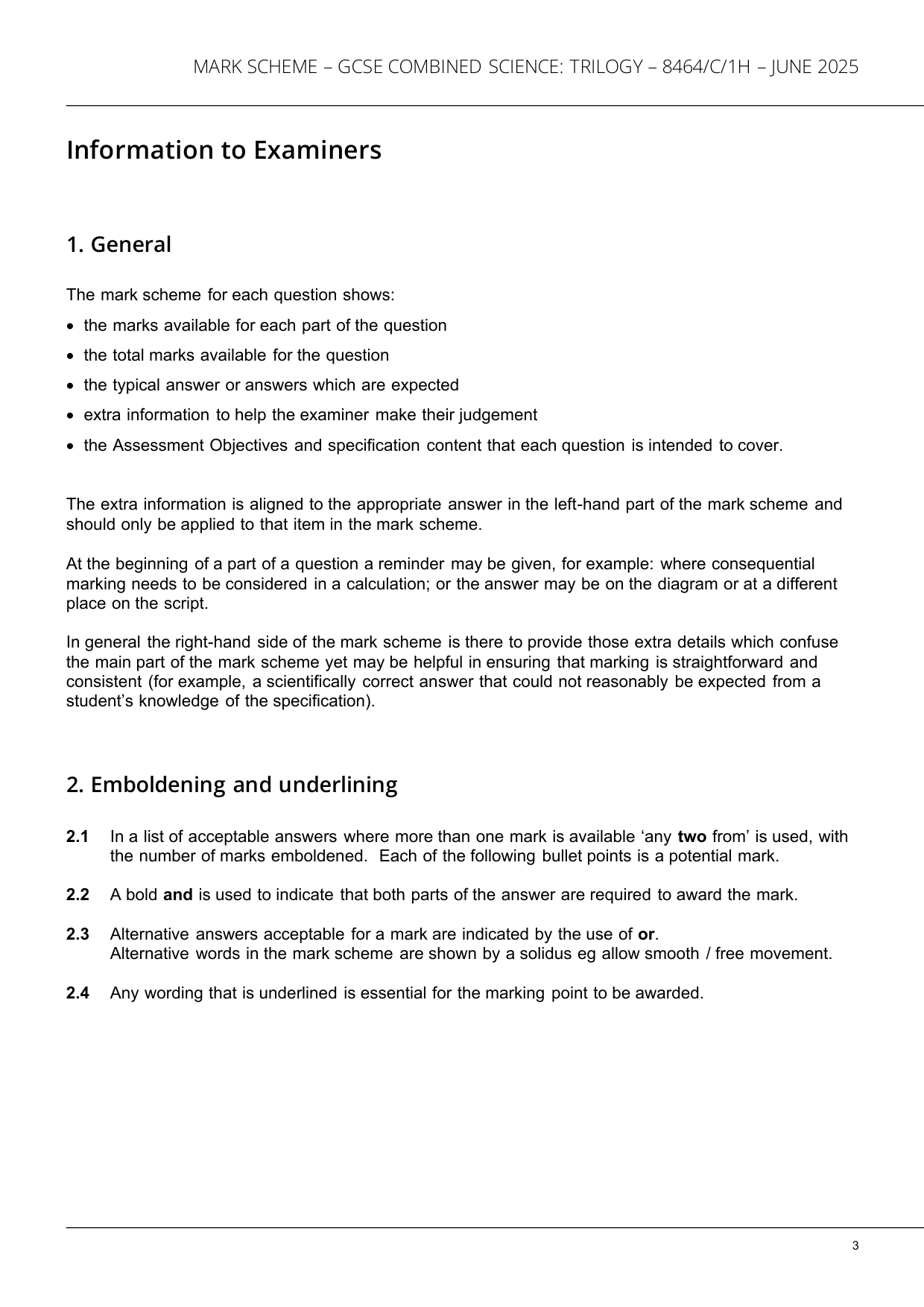
AQA GCSE Trilogy Chemistry 1H 2025 Mark Scheme PDF IMG-3
Who is this Document for ?

This document is designed for GCSE Combined Science: Trilogy Higher Tier students preparing for the 2026 AQA examination series, including Year 11 candidates targeting grades 7–9, resit students improving previous GCSE Chemistry results, and home-educated learners following the AQA 8464 specification. It is especially valuable for students learning how AQA awards marks in Higher Tier chemistry calculations, graph interpretation, required practical investigations, data analysis, and six-mark extended responses.

It is also essential for chemistry teachers, science departments, private tutors, revision-course providers, and parents supporting GCSE revision at home. The mark scheme can be used for timed mock marking, examiner-standard feedback sessions, intervention planning, standardisation exercises, and identifying common misconceptions in GCSE Chemistry assessments using authentic June 2025 examiner criteria.
What you will learn ?
How AQA awards marks for electrolysis calculations, concentration calculations in g/dm³, graph plotting, and practical electrolysis methods — plus common student errors flagged in the June 2025 series such as incorrect unit conversion and inaccurate graph plotting — so you can pre-empt them before the 2026 exam.
Examiner-approved methods for exothermic-reaction investigations involving calcium oxide, temperature-change measurements, control variables, and six-mark practical-method responses — plus common student errors flagged in the June 2025 series involving incomplete method sequencing — so you can pre-empt them before the 2026 exam.
The exact accepted explanations for atomic structure, isotopes, halogen reactivity, intermolecular forces, displacement reactions, and trends in Group 7 — plus common student errors flagged in the June 2025 series involving confusion between atoms, ions, and isotopes — so you can pre-empt them before the 2026 exam.
Mark-scheme expectations on extraction of metals, electrolysis of aluminium oxide, cryolite use, oxidation half equations, chromium extraction, and alloy hardness explanations — plus common student errors flagged in the June 2025 series involving balancing half equations incorrectly — so you can pre-empt them before the 2026 exam.
Real examiner guidance on strong and weak acids, hydrogen-ion concentration, dot-and-cross diagrams, covalent bonding, and bond-energy calculations including accepted alternative methods — plus common student errors flagged in the June 2025 series involving incorrect bond counting and electron placement — so you can pre-empt them before the 2026 exam.
How AQA assesses conservation-of-mass calculations, empirical formulas, balanced equations, ionic compounds, metallic bonding, and giant covalent versus polymer structure comparisons using level-of-response criteria — plus common student errors flagged in the June 2025 series involving incorrect mole ratios and structural terminology — so you can pre-empt them before the 2026 exam.
You may also be interested in :
Recommendations for you
AQA GCSE Trilogy Physics 2H 2025 Mark Scheme PDF
AQA
/
GCSE
AQA GCSE Trilogy Physics 2h 2025 Mark Scheme Pdf

Download AQA GCSE Trilogy Physics 2h (8464/p/2h) June 2025 Mark Scheme Pdf. Instant A...
$16
AQA GCSE Trilogy Physics 1H 2025 Mark Scheme PDF
AQA
/
GCSE
AQA GCSE Trilogy Physics 1h 2025 Mark Scheme Pdf

Download AQA GCSE Trilogy Physics 1h (8464/p/1h) June 2025 Mark Scheme Pdf. Instant A...
$16
AQA GCSE Trilogy Physics 2H 2025 Question Paper PDF
AQA
/
GCSE
AQA GCSE Trilogy Physics 2h 2025 Question Paper Pdf

Download AQA GCSE Trilogy Physics 2h (8464/p/2h) June 2025 Question Paper Pdf. Instan...

$16
AQA GCSE Trilogy Physics 1H 2025 Question Paper PDF
AQA
/
GCSE
AQA GCSE Trilogy Physics 1h 2025 Question Paper Pdf

Download AQA GCSE Trilogy Physics 1h (8464/p/1h) May 2025 Question Paper Pdf. Instant...

$16