



AQA / GCSE
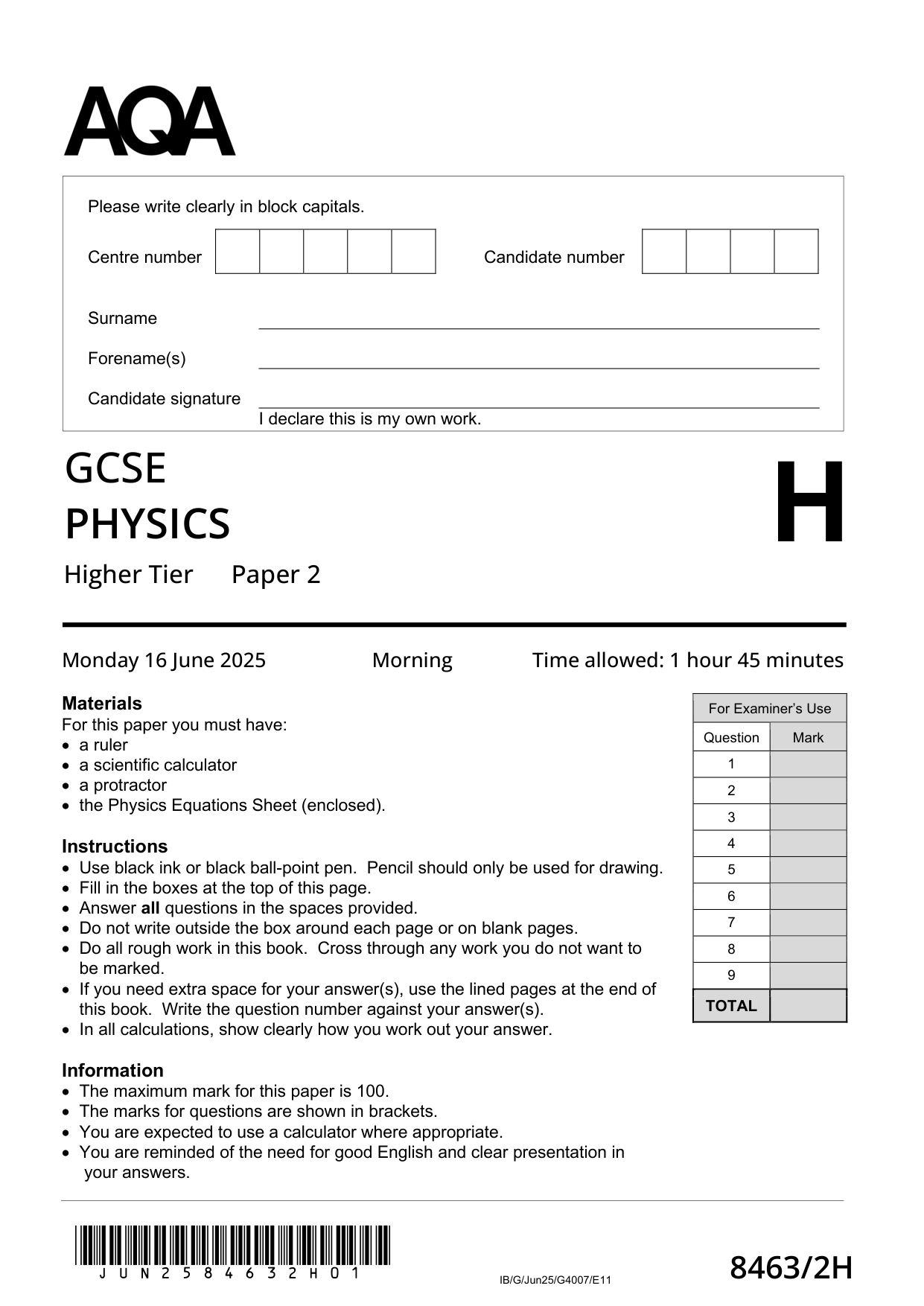
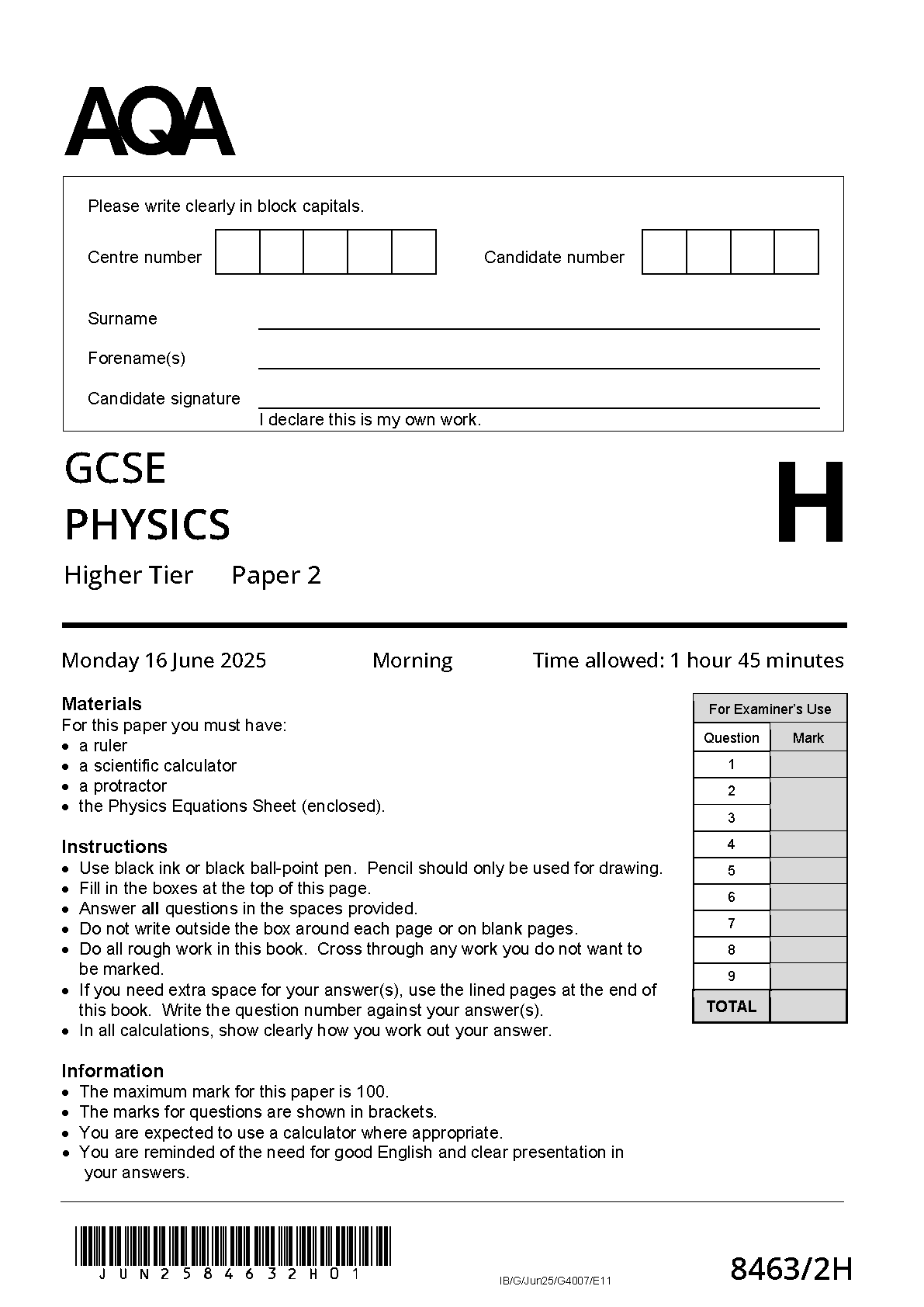
AQA GCSE Physics Paper 2 2025 Question Paper
Get the official AQA GCSE Physics Paper 2 Higher Tier (8463/2H) question paper from the **16 June 2025 morning exam** — the exact paper used across UK exam centres. This paper is worth **100 marks** and covers forces, waves, magnetism, electromagnetism, pressure, space physics, and motion.
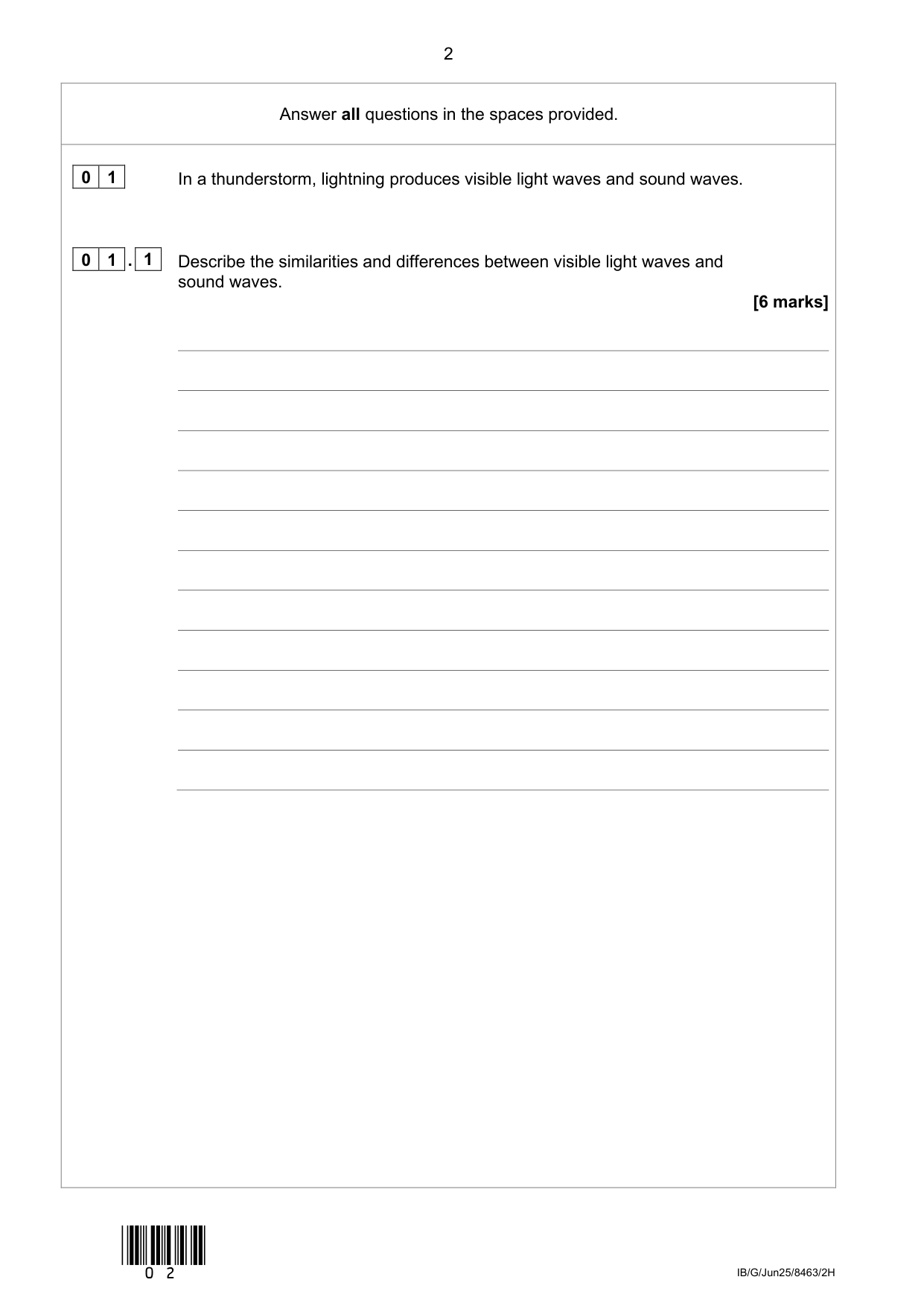
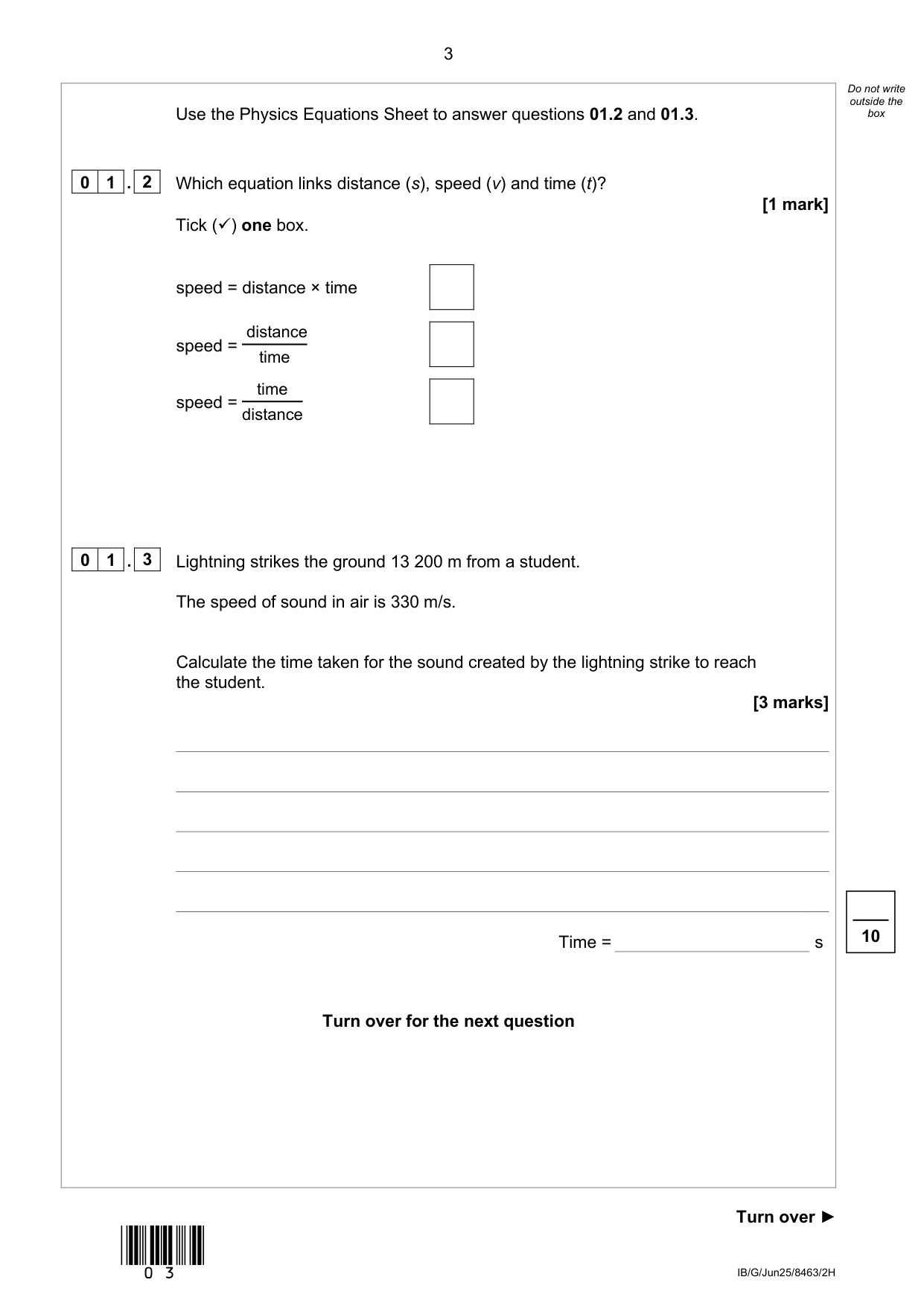
The paper begins with waves and lightning in *Question 1 (pages 2–3)*. Students compare visible light waves and sound waves by describing similarities and differences in wave behaviour, including transverse and longitudinal wave types. The section also includes a calculation using the speed equation.
Students calculate the time taken for thunder to travel 13 200 m at a sound speed of 330 m/s.
Forces and springs are explored in *Question 2 (pages 4–7)* through a required practical investigation. Students identify variables, evaluate risks, improve measurement accuracy, interpret a force-extension graph, explain why the graph curves above 6.0 N, and calculate the spring constant using Hooke’s Law
The question develops practical, graph-analysis, and calculation skills linked to elasticity and the limit of proportionality.
Experimental methods and motion are assessed in *Question 3 (pages 8–10)* using a “gravity ball” investigation. Students calculate uncertainty from repeated measurements, identify random errors, explain possible causes of measurement variation, and determine acceleration from the gradient of a graph of height against time squared using The section focuses heavily on required-practical and data-analysis skills.
Space physics and electromagnetic waves appear in *Question 4 (pages 11–13)*. Students complete a ray diagram for a converging lens in a telescope, calculate electromagnetic wave frequency from wavelength data using and explain red-shift observations from distant galaxies. The James Webb Space Telescope is used as the context for questions on cosmology, galaxy movement, and satellite motion.
Skydiving and forces are investigated in *Question 5 (pages 14–17)*. Students complete a free-body diagram, calculate velocity after 2.5 minutes of acceleration, explain how terminal velocity occurs, describe changes in atmospheric pressure with height, and determine a resultant force using vector diagrams involving vertical and horizontal forces.
Motion and braking physics are covered in *Question 6 (pages 19–21)*. Topics include acceleration comparisons between cars of different masses, how airbags reduce injury by increasing stopping time, and a deceleration calculation requiring the use of SUVAT equations and Newton’s Second Law. Students also explain why brakes heat up and identify risks linked to large deceleration.
Magnetism and the motor effect are explored in *Question 7 (pages 22–25)*. Students determine the direction of acceleration in a motor-effect apparatus, calculate acceleration using magnetic flux density, current, and force equations, and explain how a simple motor rotates continuously through interacting magnetic fields and split-ring commutators.
Pressure and upthrust are assessed in *Question 8 (pages 26–28)*. Students calculate pressure and area using fluid-pressure equations and explain why a piece of garlic floats at the boundary between oil and vinegar due to upthrust and density differences.
The final section, *Question 9 (pages 29–30)*, focuses on transformers and electromagnetic induction. Students explain why iron cores are used, calculate primary potential difference from transformer-turns data using
This document is designed for GCSE Physics students preparing for the 2026 exam series, particularly Year 11 students studying the AQA 8463 Higher Tier specification, as well as resit candidates and independent learners.
It is also ideal for teachers, tutors, and revision providers who need authentic exam material for mocks, timed assessments, and required-practical preparation. It supports revision across forces, waves, electromagnetism, pressure, and space physics.
Download AQA GCSE Physics 2h (8463/2h) June 2025 Mark Scheme Pdf. Instant Access.
Download AQA GCSE Physics 2h (8463/2h) June 2025 Question Paper Pdf. Instant Access.
Download AQA GCSE Physics 1h (8463/1h) June 2025 Mark Scheme Pdf. Instant Access.

Download AQA GCSE Physics 2f (8463/2f) June 2025 Mark Scheme Pdf. Instant Access.