



AQA / GCSE
AQA GCSE Physics Paper 1h 2025 Question Paper
Get the official AQA GCSE Physics Paper 1 Higher Tier (8463/1H) question paper from the **22 May 2025 morning exam** — the exact paper used across UK exam centres. This paper is worth **100 marks** and covers energy, electricity, particle models, atomic structure, and radioactivity.
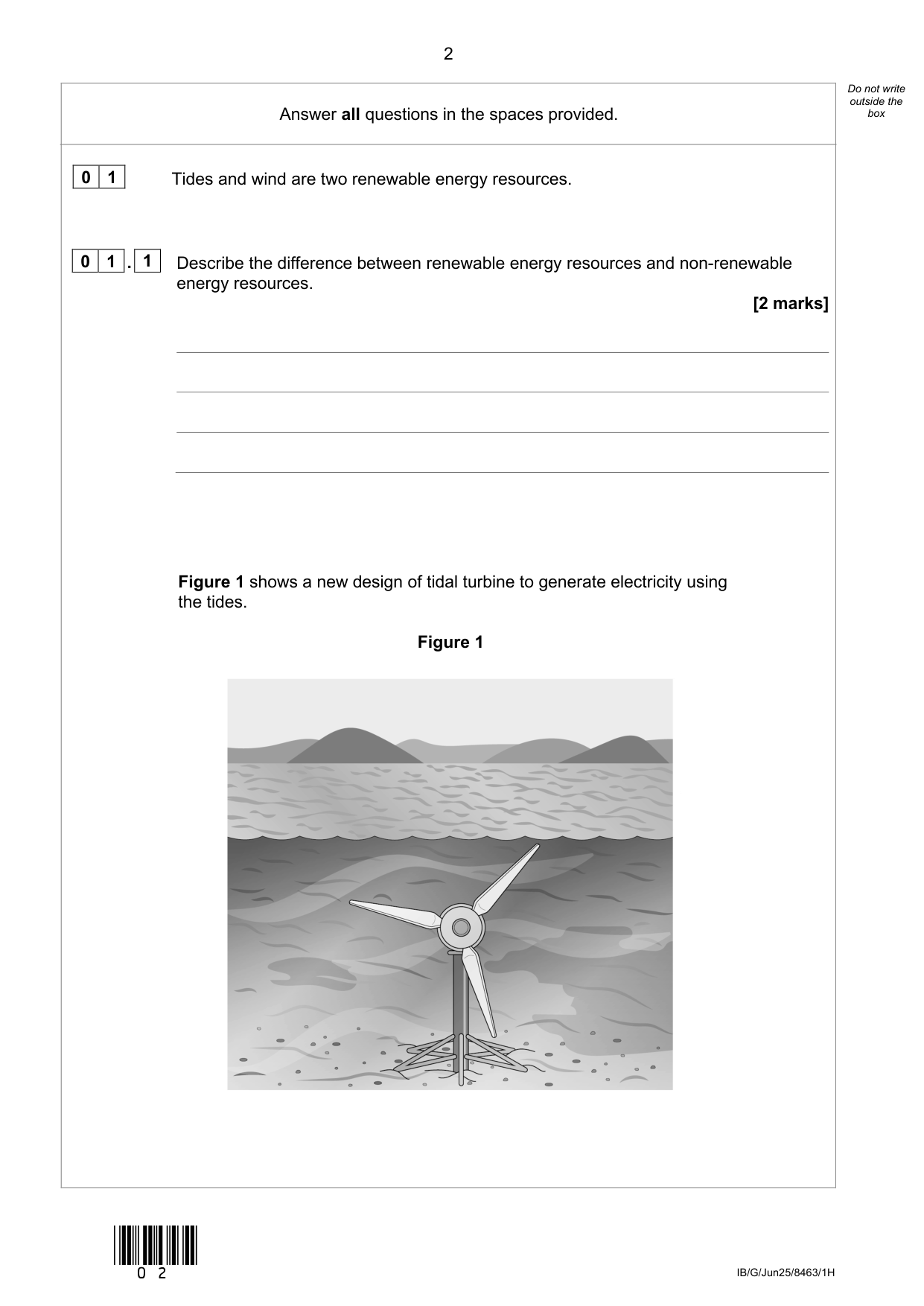
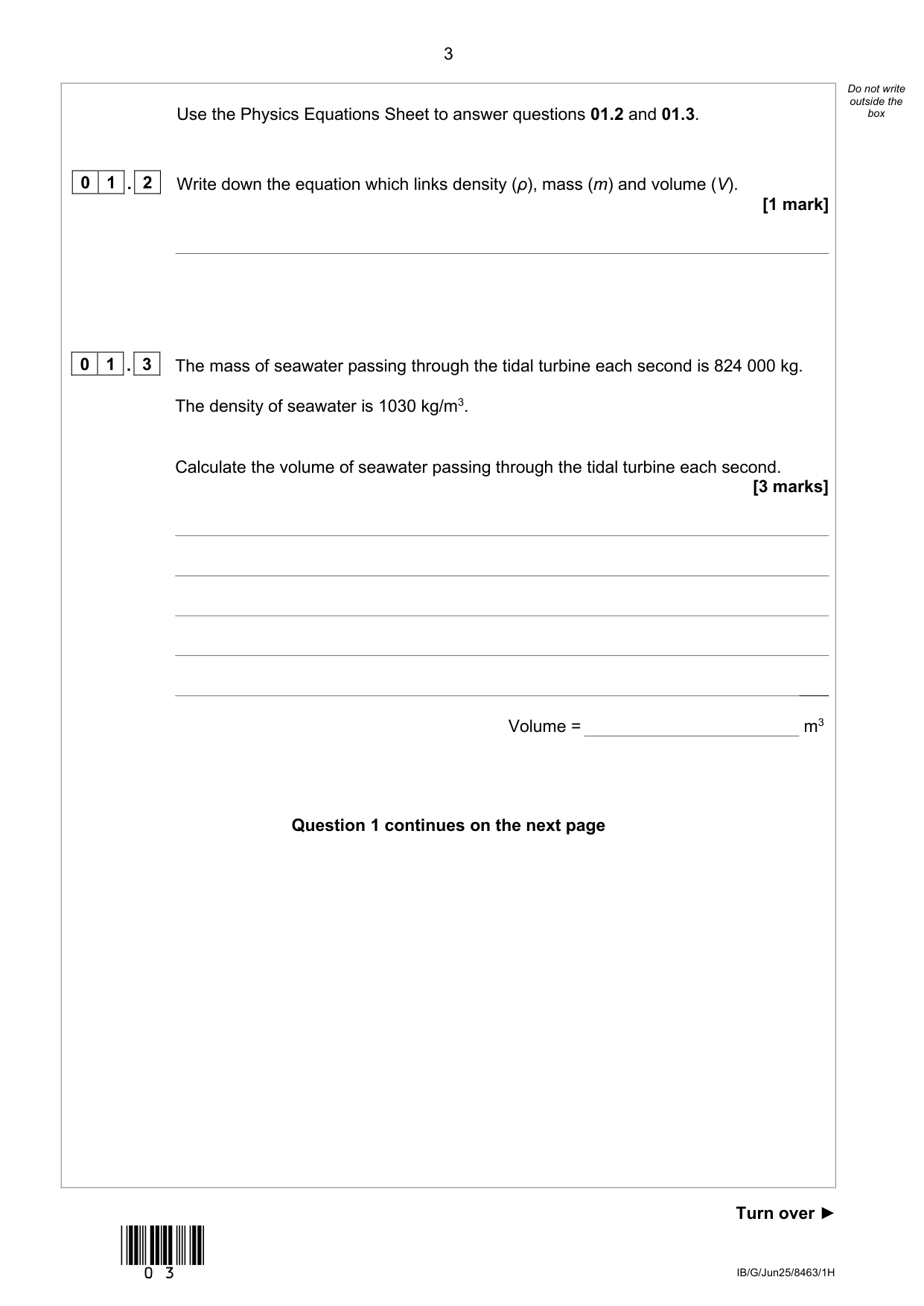
The paper begins with renewable energy and tidal turbines. *Question 1 (pages 2–5)* explores renewable vs non-renewable energy resources, density calculations using seawater flow through a tidal turbine, and interpretation of graphs comparing tidal and wind turbine power output. Students also compare environmental impacts of tidal and wind turbines using Figure 3.
Practical and thermal physics skills are assessed in *Question 2 (pages 6–7)* through a required practical investigating the specific heat capacity of water. Students identify hazards, describe methods using a joulemeter and heater, suggest ways to reduce energy loss, and calculate percentage difference between experimental and actual values.
Electricity and resistance are covered in *Question 3 (pages 8–10)*. Students analyse an LED circuit with ammeters and voltmeters, apply the equation linking potential difference, current, and resistance, determine resistance from a graph at 3.0 V, and explain why reversing the power supply gives a current of 0.0 A.
Environmental physics appears in *Question 4 (pages 11–13)*. Topics include carbon dioxide emissions from petrol and electric cars, interpretation of lifetime emissions graphs, environmental problems caused by CO₂, and identifying energy resources that do not emit carbon dioxide during electricity generation, such as nuclear and solar.
Nuclear fusion and atomic structure are explored in *Question 5 (pages 14–15)*. Students explain isotopes, energy release in nuclear fusion, why reactor walls require materials with high specific heat capacity, and the dangers of uncontrolled nuclear fission chain reactions.
Heating, electrical energy transfer, and circuits are assessed in *Question 6 (pages 16–18)* using a battery-powered hand warmer. Students calculate temperature increase using specific heat capacity, determine charge flow from energy transfer and voltage, and explain how power output changes when multiple switches are closed in the circuit diagram shown in Figure 9.
Atomic models and radioactivity are covered in *Question 7 (pages 19–21)*. Students explain why atomic models change with new evidence, compare irradiation and contamination, complete a nuclear decay equation for polonium-210, calculate half-life decay time, and compare activities of different isotopes.
Particle physics and gases appear in *Question 8 (pages 22–23)*. Students calculate the specific latent heat of vaporisation of nitrogen, explain changes in internal energy during boiling, and describe how gas pressure changes as temperature increases in a sealed container.
Mechanics and energy transfers are explored in *Question 9 (pages 24–25)* using a garden water feature. Students calculate the mass of water moved by a pump each second, determine charge flow through a motor over 30 minutes, and explain how increasing motor efficiency affects water flow.
The final section, *Question 10 (pages 26–29)*, investigates elastic potential energy and motion using a toy car launcher. Students calculate the maximum possible speed of a toy car using spring constant and mass data, explain changes in energy stores around a looped track, and identify measurements needed to determine speed using a light gate.
Use this paper to practise under real exam conditions, improve equation skills, and strengthen extended scientific explanations for higher-tier physics questions. Pair it with the AQA 8463/1H June 2025 mark scheme for complete exam preparation.
This document is designed for GCSE Physics students preparing for the 2026 exam series, particularly Year 11 students studying the AQA 8463 Higher Tier specification, as well as resit candidates and independent learners.
It is also ideal for teachers, tutors, and revision providers who need authentic exam material for mocks, timed assessments, and required-practical preparation. It supports revision across electricity, energy transfers, particle models, and radioactivity.
Download AQA GCSE Physics 2h (8463/2h) June 2025 Mark Scheme Pdf. Instant Access.
Download AQA GCSE Physics 2h (8463/2h) June 2025 Question Paper Pdf. Instant Access.
Download AQA GCSE Physics 1h (8463/1h) June 2025 Mark Scheme Pdf. Instant Access.

Download AQA GCSE Physics 2f (8463/2f) June 2025 Mark Scheme Pdf. Instant Access.