



AQA / GCSE
AQA GCSE Chemistry Paper 2h 2025 Mark Scheme
Get the official AQA GCSE Chemistry Paper 2 Higher Tier (8462/2H) **June 2025 mark scheme (Version 1.0 Final)** — the examiner-approved document used to award marks across all **100 marks** of the exam. It includes full answers, calculations, level descriptors, and detailed examiner guidance for every question.
The mark scheme begins with detailed examiner instructions on *pages 2–6*, including how “best fit” level marking is applied, how method marks are awarded in calculations, treatment of errors carried forward (ecf), and guidance on acceptable alternative answers.
For *Question 1 (pages 7–9)*, accepted answers include using a burette because it is **more accurate**, reheating to obtain a **constant mass**, and calculating the mean concentration of dissolved solids as **34.75 g/dm³**. The mark scheme also provides multiple valid calculation methods.
Hydrocarbon chemistry and fractional distillation are covered in *Question 2 (pages 10–11)*. Accepted answers include **fractional distillation**, **evaporation** in the heater, **condensation** in the column, identifying **butane (C₄H₁₀)** from the molecular model, and balancing the propane combustion equation to produce **3CO₂ + 4H₂O**.
The extended-response material evaluation in *Question 3 (pages 12–13)* includes a full level-based mark scheme comparing aluminium and wood for doors. Indicative content covers sustainability, recyclability, cost, corrosion resistance, and environmental impacts such as deforestation and quarrying. The section also explains that aluminium oxide acts as a **barrier** preventing oxygen and water reaching the metal.
Atmospheric chemistry is explained in *Question 4 (pages 14–15)*. The mark scheme states that nitrogen increased because of **volcanic activity**, while carbon dioxide decreased because it dissolved in oceans and formed carbonate sediments. It also confirms that oxygen levels increased due to **photosynthesis by algae/plants/cyanobacteria**.
Organic chemistry answers appear in *Question 5 (pages 16–18)*. Accepted responses include **ethanol** as the product of ethene hydration, the chlorine test using **damp litmus paper bleached white**, and identifying **propene** as C₃H₆. The gas-volume calculation gives **1200 cm³** for 2.1 g of propene at room temperature and pressure.
Chemical analysis is covered in *Question 6 (pages 19–20)*. Accepted answers include calcium/magnesium/zinc ions forming white precipitates with sodium hydroxide, confirmation of aluminium ions by adding **excess sodium hydroxide**, and identifying chloride ions using silver nitrate. The mark scheme also explains why ethanoic acid reacts more slowly because it is a **weak acid** with a lower concentration of hydrogen ions.
Polymer chemistry and condensation polymers are assessed in *Question 7 (pages 21–22)*. The mark scheme identifies **ethanediol** and **hexanedioic acid** as monomers, confirms **polyester** and **polypeptide** formation, and explains that thermosetting polymers contain **cross-links/covalent bonds between polymer chains**.
Rates of reaction and catalysis are explained in *Question 8 (pages 23–24)*. Accepted answers include oxygen gas escaping from the flask, catalysts providing an **alternative reaction pathway with lower activation energy**, and explanations of why higher temperatures increase collision frequency and energy.
The final section, *Question 9 (pages 25–26)*, covers equilibrium and ammonia production. The mark scheme explains that the forward reaction is **endothermic**, so high temperatures shift equilibrium to the right. It also confirms that catalysts have **no effect on equilibrium position**, calculates the required air volume as **62.5 dm³**, and explains ammonia separation through cooling and condensation. Sustainability answers include references to nitrogen abundance, reduced greenhouse gas emissions, and methane being a finite resource.
Use this mark scheme to accurately mark your answers, understand examiner expectations, and improve extended-response techniques. Pair it with the AQA 8462/2H June 2025 question paper for complete exam preparation.
This document is designed for GCSE Chemistry students preparing for the 2026 exam series, particularly Year 11 students studying the AQA 8462 Higher Tier specification, as well as resit candidates and independent learners.
It is also ideal for teachers, tutors, and revision providers who need accurate mark schemes for marking mock exams, standardising grading, and teaching exam technique. It supports detailed feedback across organic chemistry, equilibrium, polymers, rates of reaction, and atmospheric chemistry.
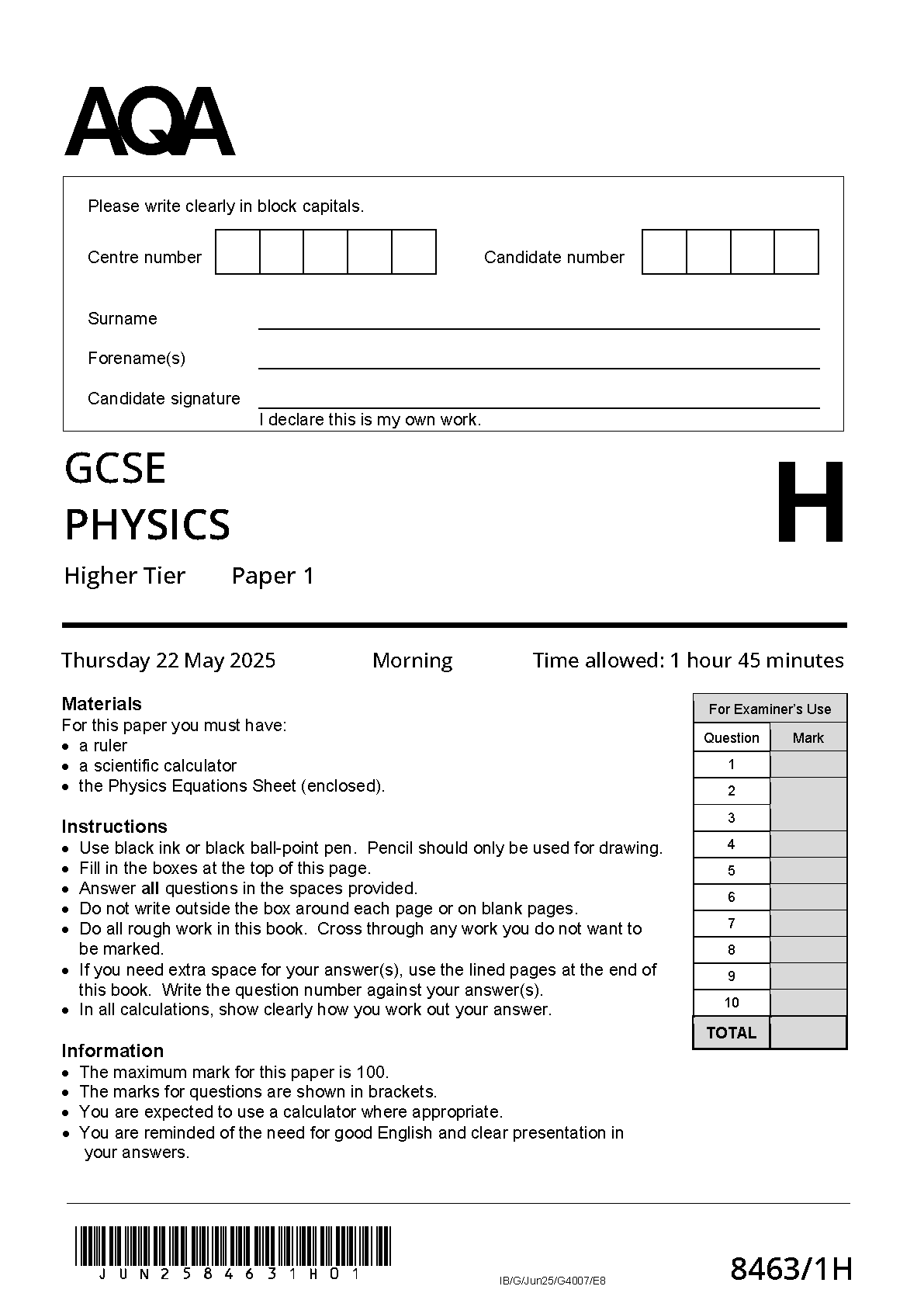
Download AQA GCSE Physics 1h (8463/1h) May 2025 Question Paper Pdf. Instant Access.
Download AQA GCSE Chemistry 2h (8462/2h) June 2025 Mark Scheme Pdf. Instant Access.

Download AQA GCSE Chemistry 2h (8462/2h) June 2025 Question Paper Pdf. Instant Access...
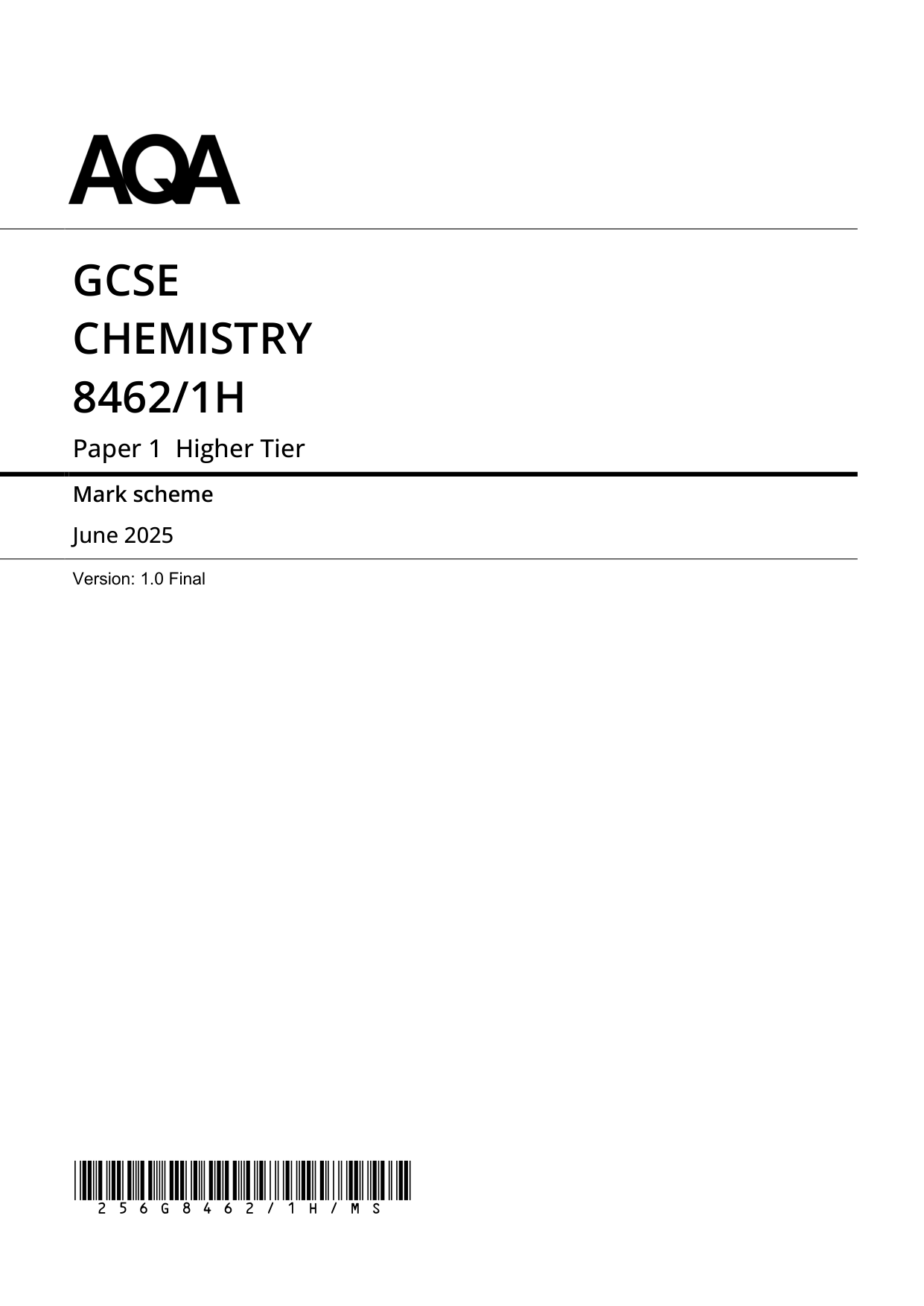
Download AQA GCSE Chemistry 1h (8462/1h) June 2025 Mark Scheme Pdf. Instant Access.