



OCR / A Level
OCR A Level Physical Education Paper 1 2025 Question Paper
Download the official OCR A Level Physical Education H555/01 Physiological Factors Affecting Performance question paper from the June 2025 examination series. This downloadable PDF contains the complete OCR A Level PE Paper 1 exam sat on Friday 23 May 2025, including multiple-choice questions, biomechanics tasks, physiology analysis, practical sporting applications, graph-based questions, and extended-response essays in the official OCR exam format.
The OCR H555/01 June 2025 question paper covers a broad range of advanced physiological and biomechanical topics including skeletal muscles, the cardiac cycle, excess post-exercise oxygen consumption (EPOC), sports injuries, Bernoulli’s principle, muscle-fibre characteristics, cardiovascular regulation, respiratory-system measurements, altitude training, ergogenic aids, aerobic-capacity testing, flexibility measurement, atherosclerosis, warm ups and cool downs, limb kinematics, angular momentum, fluid resistance, projectile motion, and plyometric training.
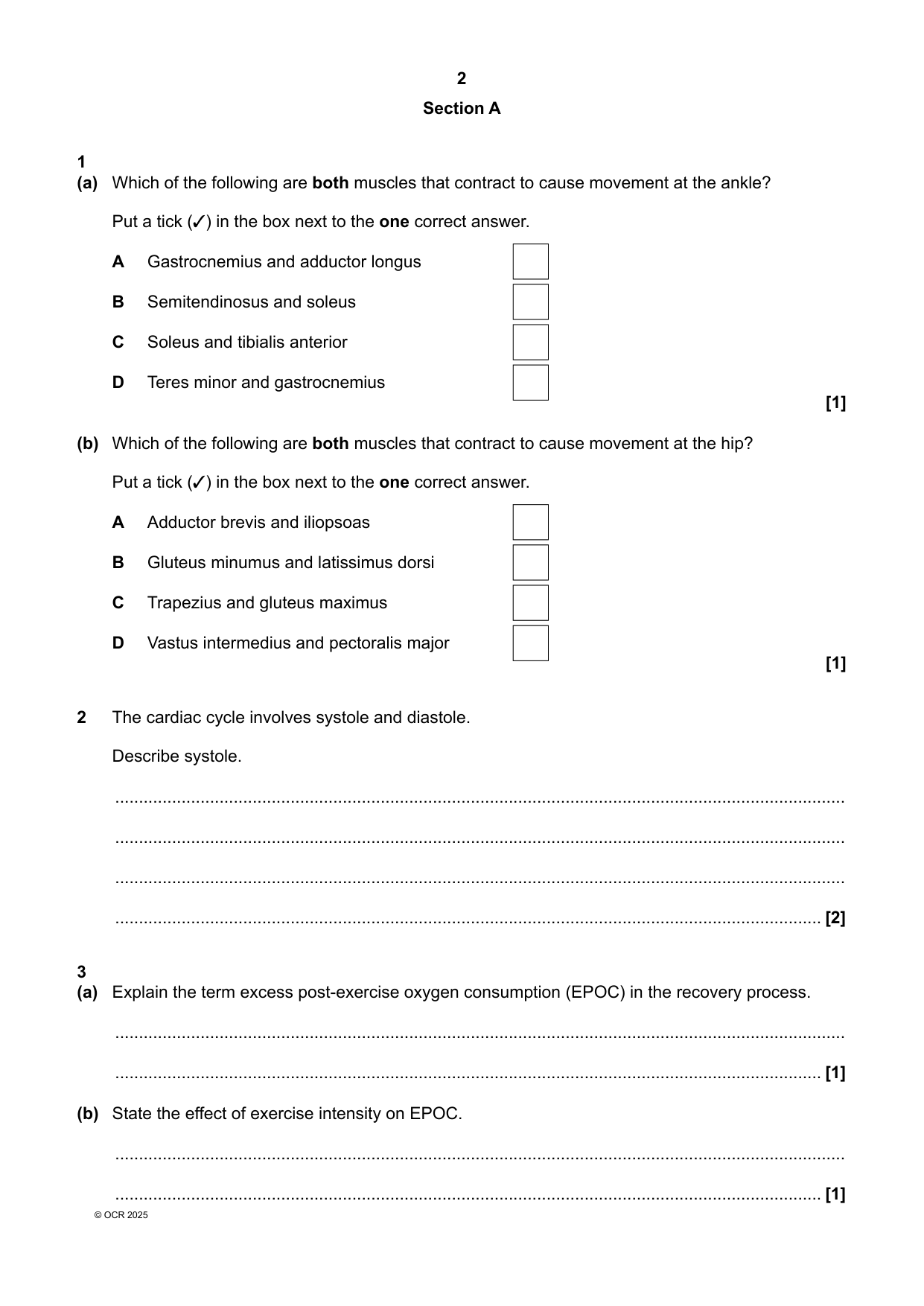
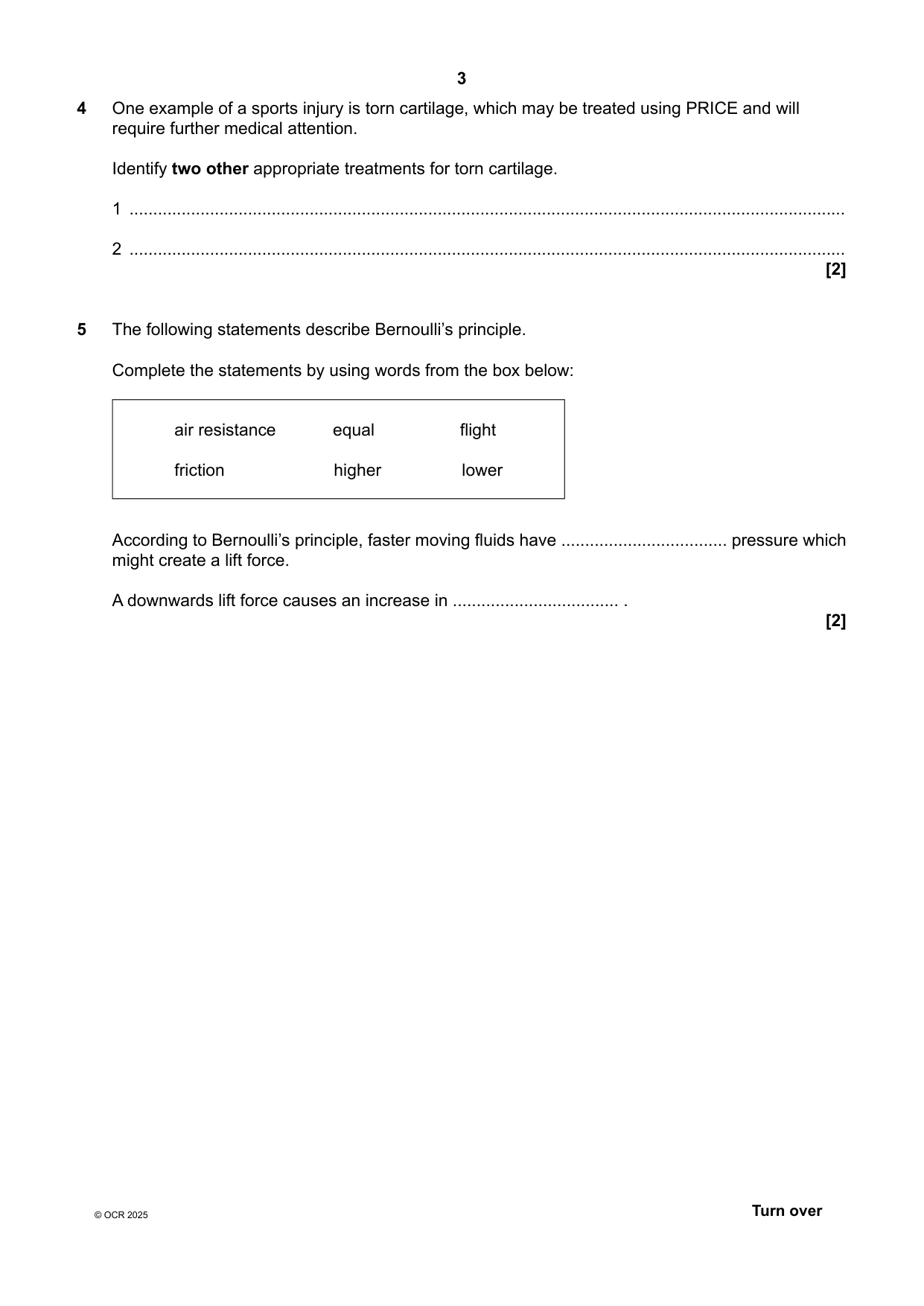
Section A begins with multiple-choice and short-answer questions on muscular movement at the ankle and hip, systole within the cardiac cycle, recovery and EPOC, treatment of torn cartilage injuries, and Bernoulli’s principle in relation to lift force and air resistance. Students must apply accurate anatomical and physiological terminology throughout their responses.
Question 6 explores muscle-fibre characteristics and cardiovascular physiology. Candidates evaluate slow oxidative muscle fibres for hockey performance, explain intrinsic regulation of heart rate at the start of exercise, complete respiratory-system tables for tidal volume and breathing frequency, sketch minute-ventilation graphs during exercise and recovery, and analyse short-term cardiovascular responses to high-altitude performance.
Question 7 focuses on training methods, nutritional aids, aerobic-capacity testing, and health-related exercise. Students explain the benefits and risks of creatine and nitrate supplementation, describe the Queen’s College step test, explain the use of a goniometer for knee flexibility measurement, define atherosclerosis, and evaluate how regular training reduces cardiovascular disease risk. The paper also requires discussion of warm ups and cool downs in preventing sports injuries.
Question 8 examines biomechanics and rotational motion in sport. Students apply limb kinematics to javelin performance, define angular momentum, calculate its formula, and explain conservation of angular momentum during a forward somersault dive using the illustrated dive sequence shown in the paper. Candidates also analyse fluid resistance acting against movement through water and explain why the flight path of a shuttlecock is non-parabolic due to air resistance and drag forces.
The extended-response Section C contains a 20-mark synoptic essay requiring students to define Newton’s Laws of Motion, apply them to sprinting performance, describe plyometric strength training for sprinters, and analyse physiological adaptations from plyometric training. Responses are limited specifically to muscle and connective tissue adaptations, neural adaptations, and metabolic adaptations.
The paper integrates AO1 knowledge, AO2 sporting application, and AO3 analytical evaluation throughout all sections. OCR expects candidates to use detailed sporting examples, scientific terminology, biomechanical analysis, and balanced physiological evaluation in extended written responses.
This OCR A Level Physical Education H555/01 question paper is ideal for timed exam practice, biomechanics revision, physiology analysis, essay-planning exercises, classroom discussion, and improving AO1 knowledge, AO2 sporting application, and AO3 evaluative skills under authentic OCR examination conditions. Pair this paper with the official OCR H555/01 June 2025 mark scheme for complete examiner-standard revision and performance analysis. Updated for the 2025/2026 academic year, fully mobile-friendly, and instantly downloadable.
This document is designed for OCR A Level Physical Education students preparing for the 2026 examination series, resit candidates improving Physiological Factors Affecting Performance exam performance, home-educated learners, and independent candidates studying A Level PE. It is especially valuable for students practising biomechanics application, physiological analysis, essay-writing skills, and OCR examiner-style evaluation techniques.
Teachers, tutors, PE departments, revision-course providers, intervention coordinators, and parents can use this official OCR question paper for mock examinations, classroom discussion, retrieval practice, biomechanics workshops, and benchmarking student responses against live OCR assessment standards from the June 2025 series.
Download OCR A Level PE H555/03 June 2025 Question Paper Pdf For Socio-cultural Issue...
Download OCR A Level PE H555/02 June 2025 Question Paper Pdf For Psychological Factor...
Download OCR A Level PE H555/03 June 2025 Mark Scheme Pdf For Socio-cultural Issues R...
Download OCR A Level PE H555/02 June 2025 Mark Scheme Pdf For Psychological Factors R...