



AQA / A Level
AQA A Level Media Studies Paper 1 2025 Mark Scheme
Access the official AQA A-Level Media Studies Paper 1 mark scheme for the June 2025 exam series (7572/1), version 1.0 Final. This is the examiner-approved document used during standardisation and live marking to ensure consistent grading across all candidates.
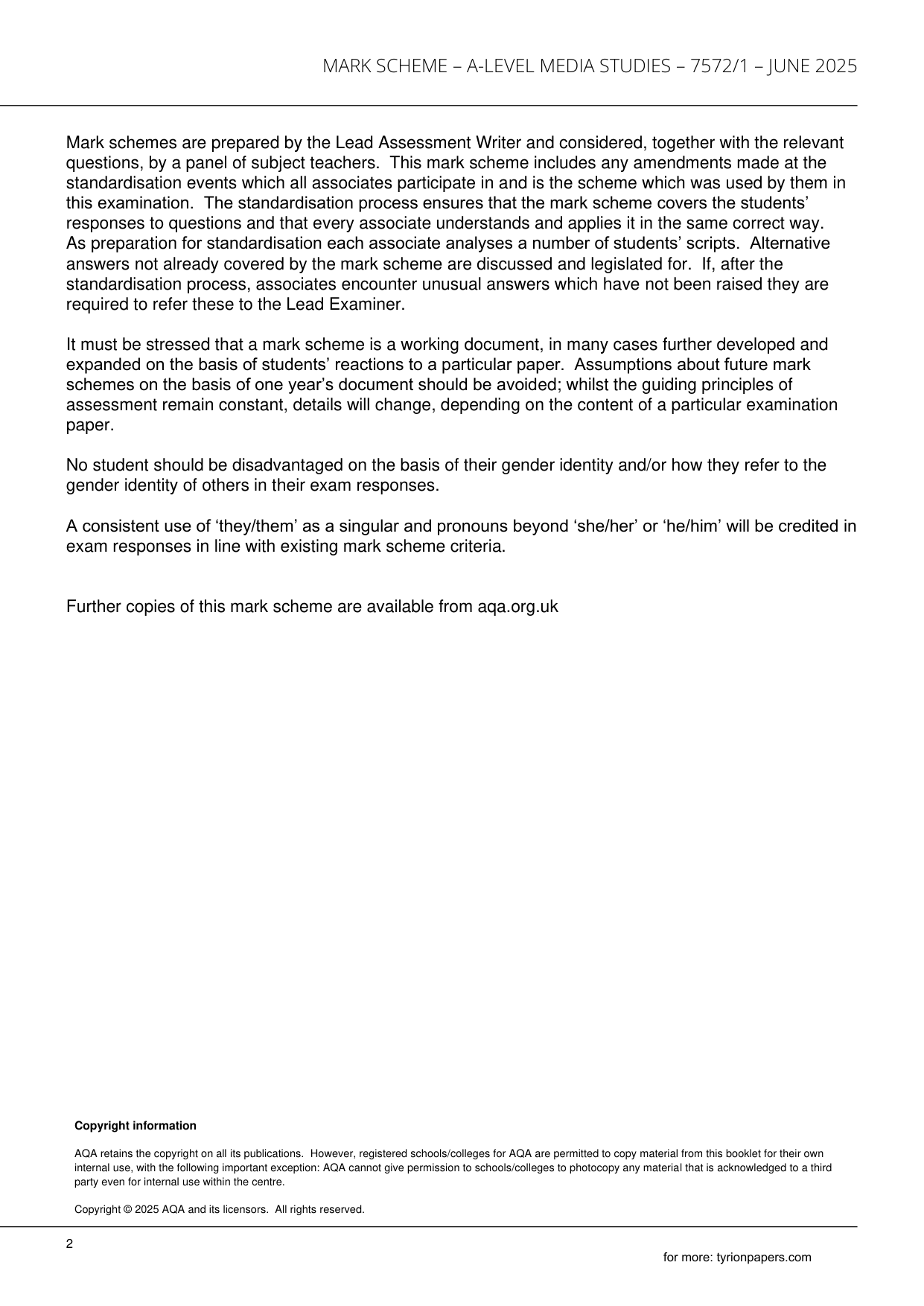
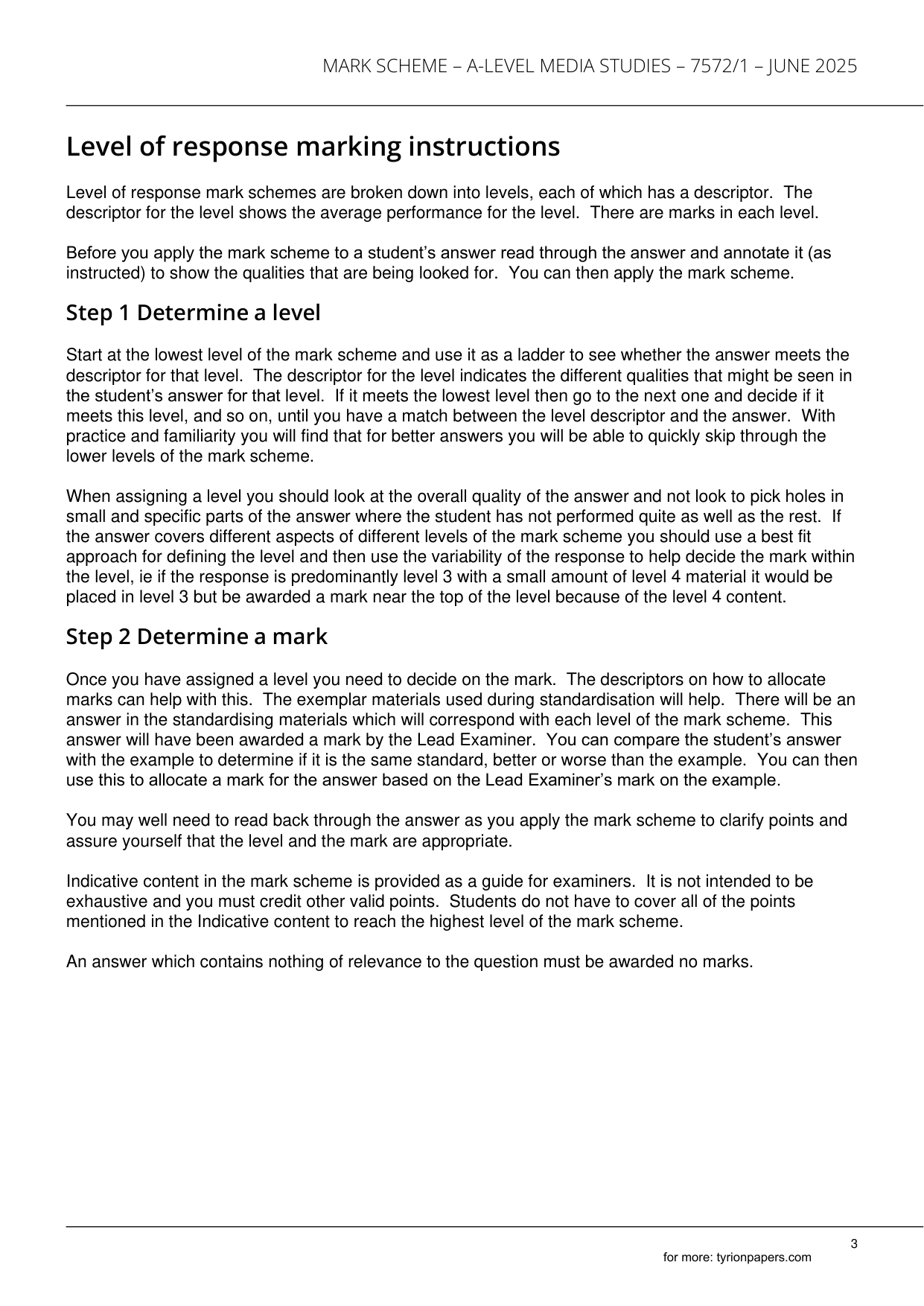
The mark scheme provides detailed level descriptors, indicative content, and examiner guidance for every question across Media Language, Media Representations, Media Industries, and Media Audiences. Early pages explain AQA’s level-of-response system, including the “best fit” marking approach where overall quality determines the final level awarded (pages 2–3).
Question 1 (pages 4–5) analyses how anchorage works in the National Trust advertisement. The mark scheme explains how verbal elements such as “What will take your breath away?” and “Time well spent” shape audience interpretation through semiotics and media language theory. Higher-level responses are expected to critically engage with nuanced meanings and use subject-specific terminology accurately.
Question 2 (pages 6–8) explores representations of place in *Ghost Town* and the National Trust advertisement, linking them to political and historical contexts. Indicative content highlights themes such as Thatcher-era urban deprivation, rural conservatism, stereotypes of English countryside identity, and ideological representations of place.
Question 3 (pages 9–11) evaluates intertextuality in *Old Town Road*. The mark scheme explains how references to Western films, country music, hip-hop culture, and hybrid genre conventions create meaning. It also discusses parody, pastiche, audience decoding, and representations of race and identity.
The extended-response Question 4 (pages 12–15) evaluates Judith Butler’s theory that gender is a subversive performance. Students must apply theory to the advertising CSPs *Score* and *Sephora*. Indicative content explores gender performativity, feminism, postmodernism, queer theory, social change, and non-binary identity representations across different historical periods.
Section B covers media industries and audiences. Question 5 (pages 16–17) provides exact definitions for key ‘End of Audience’ terms including digital natives, convergence, and prosumers. Question 6 (pages 18–19) analyses how *Newsbeat* creates resonance through youth-oriented editorial choices, audience targeting, and distinctive radio conventions.
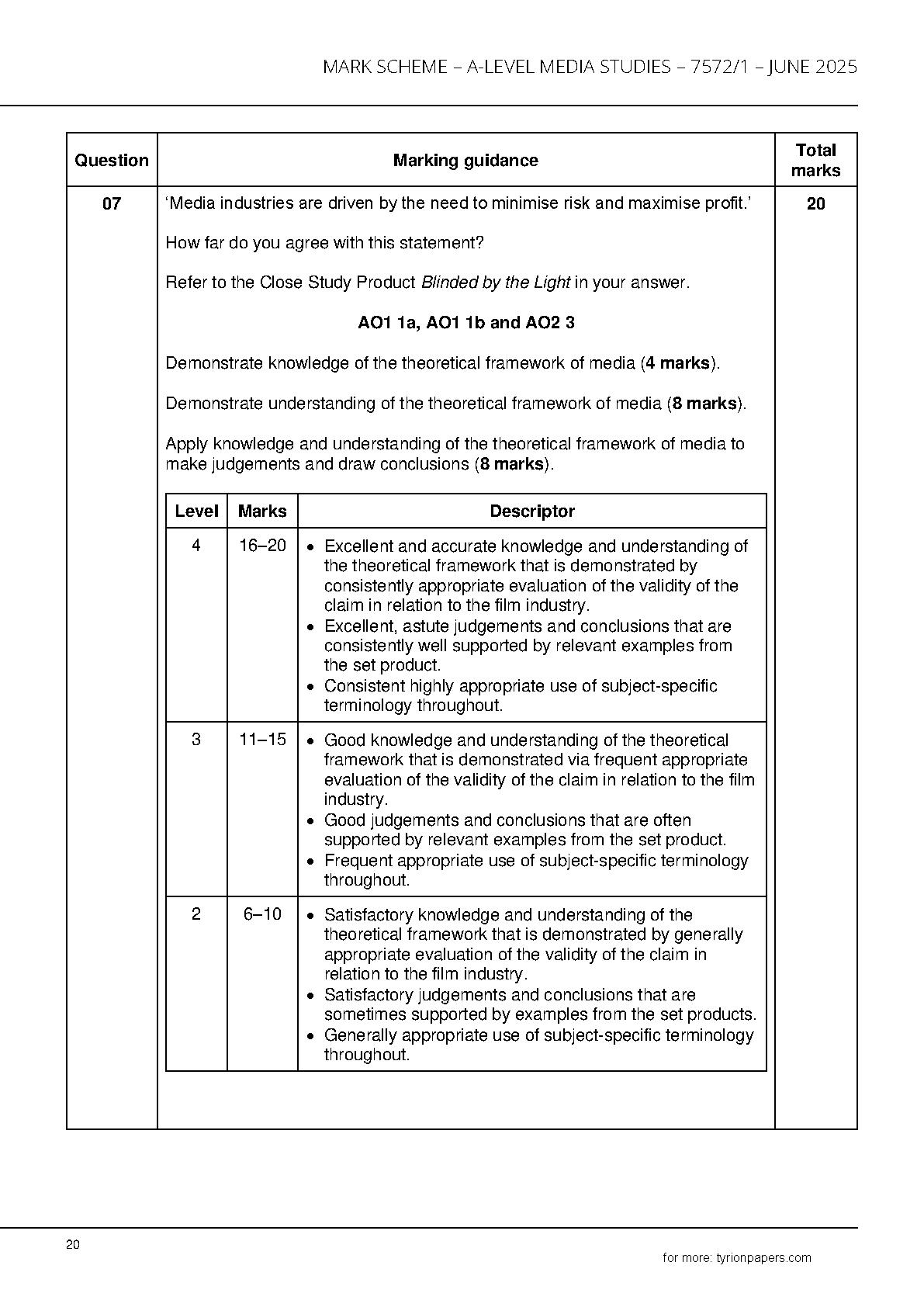
The final 20-mark essay (pages 20–22) evaluates whether media industries are driven by minimising risk and maximising profit, using *Blinded by the Light* as a case study. Indicative content includes discussion of co-productions, vertical integration, audience fragmentation, streaming distribution, brand synergy, and Hesmondhalgh’s cultural industries theory.
Use this mark scheme to understand exactly how AQA awards marks, what examiners expect for top-level responses, and how to structure analytical essays for the 2026 A-Level Media Studies exams.
This document is for A-Level Media Studies students preparing for the 2026 exam series, especially Year 13 students and retake candidates aiming for top grades.
It is also highly valuable for teachers, tutors, and revision providers who need accurate examiner guidance, level descriptors, and model analytical frameworks for marking essays and improving student performance.
Download AQA A Level Media Studies Paper 2 (7572/2) 2025 Mark Scheme Pdf. Instant Acc...
Download AQA A Level Media Studies Paper 2 (7572/2) June 2025 Question Paper Pdf. Ins...
Download AQA A Level Media Studies Paper 1 (7572/1) May 2025 Question Paper Pdf. Inst...